Beket Ata Underground Mosque
Journey to the edge of the world. Mars on Earth.
Essential Profile
The Saint in the Cliff
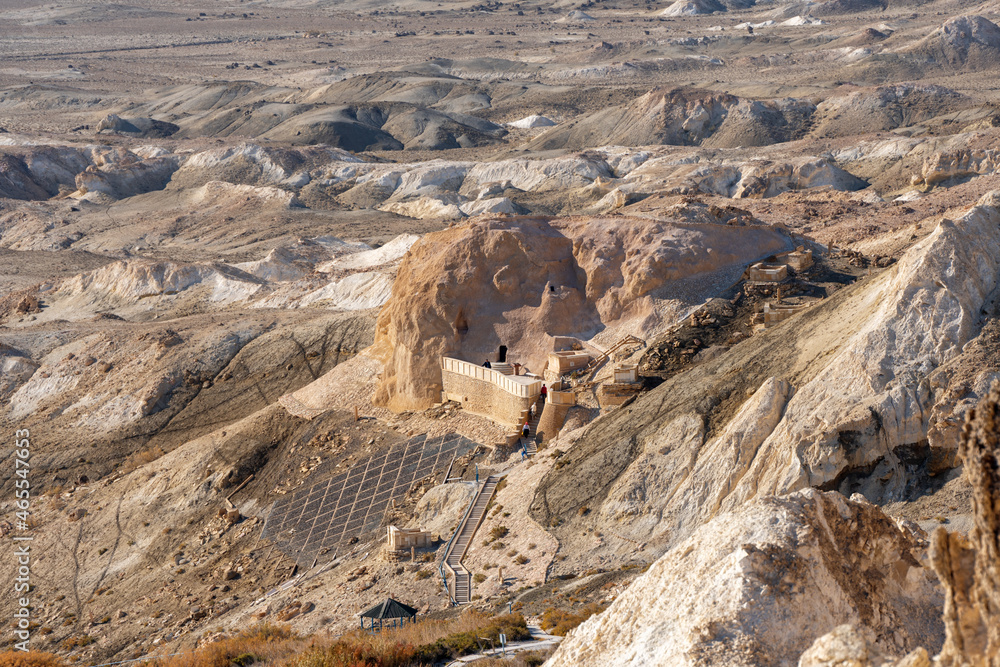
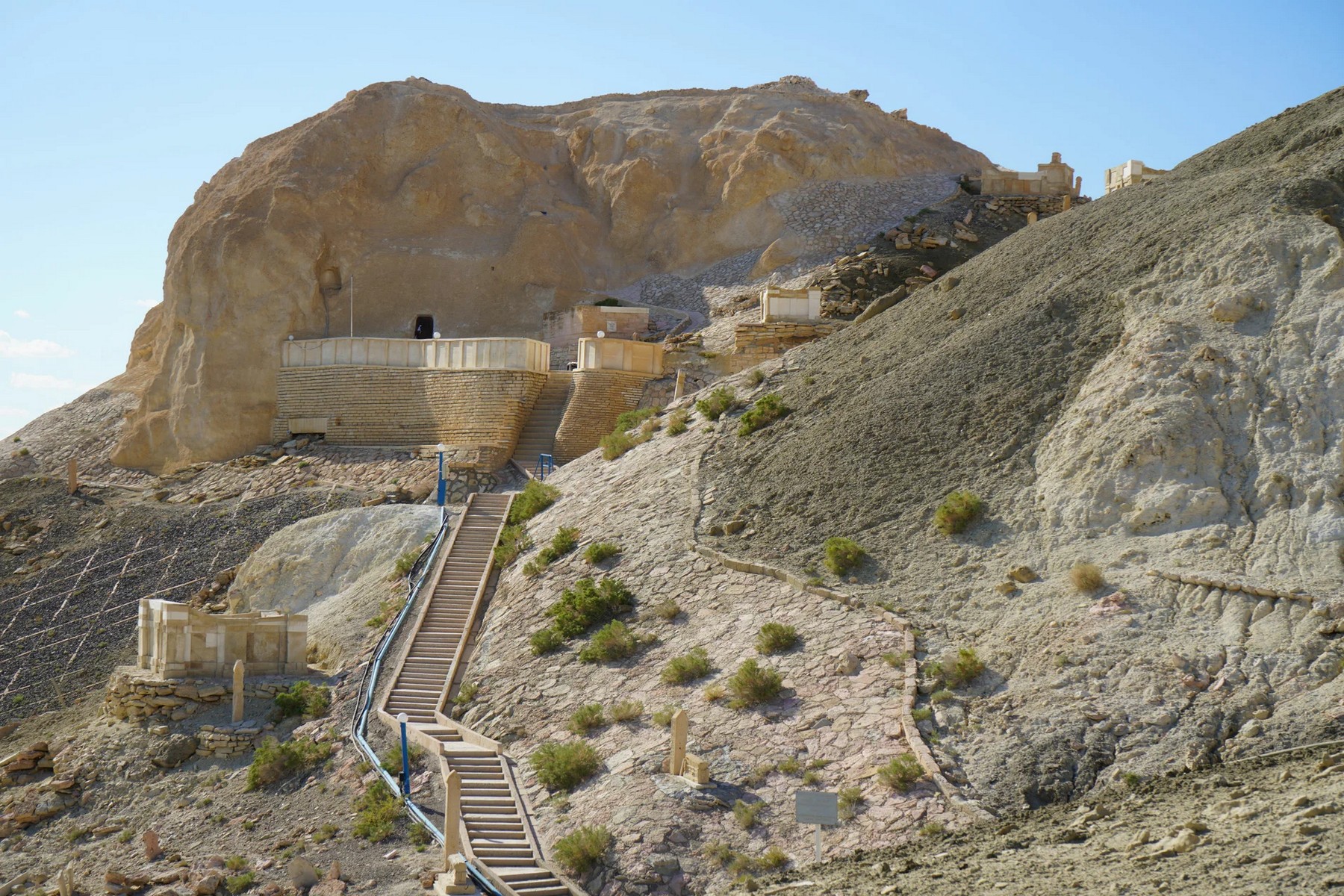
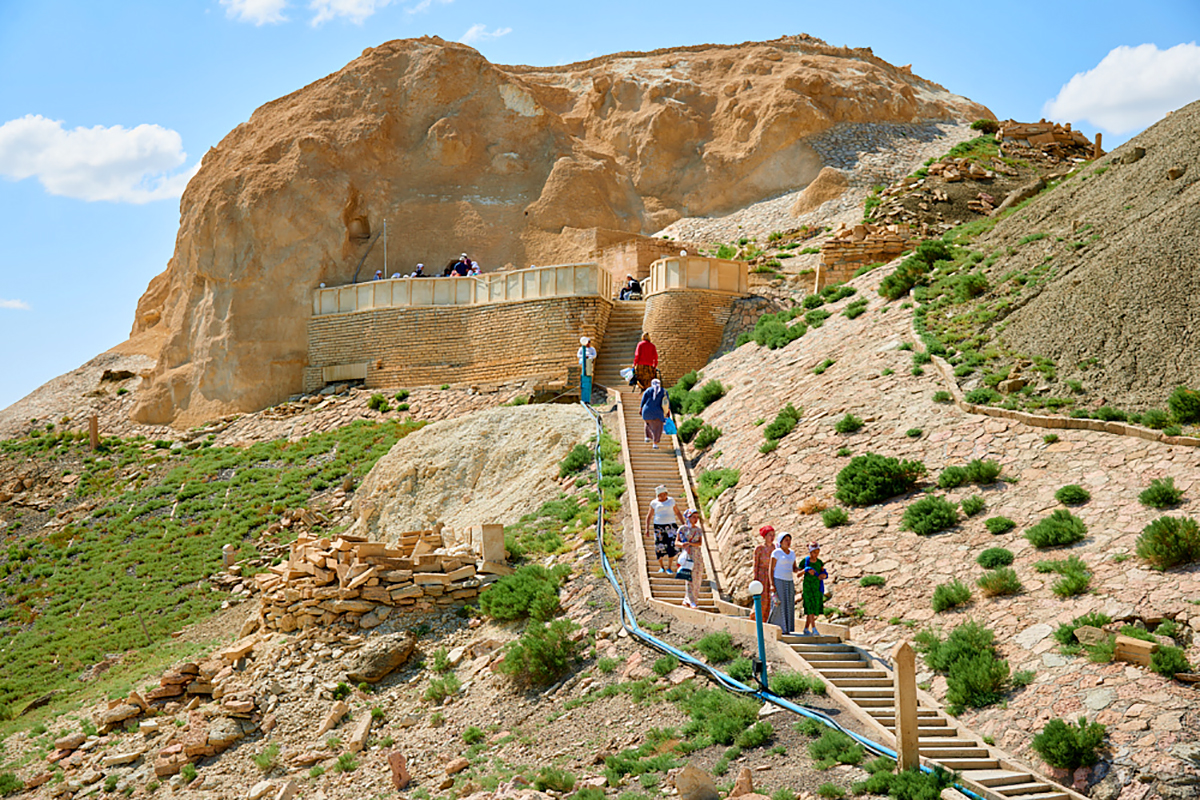
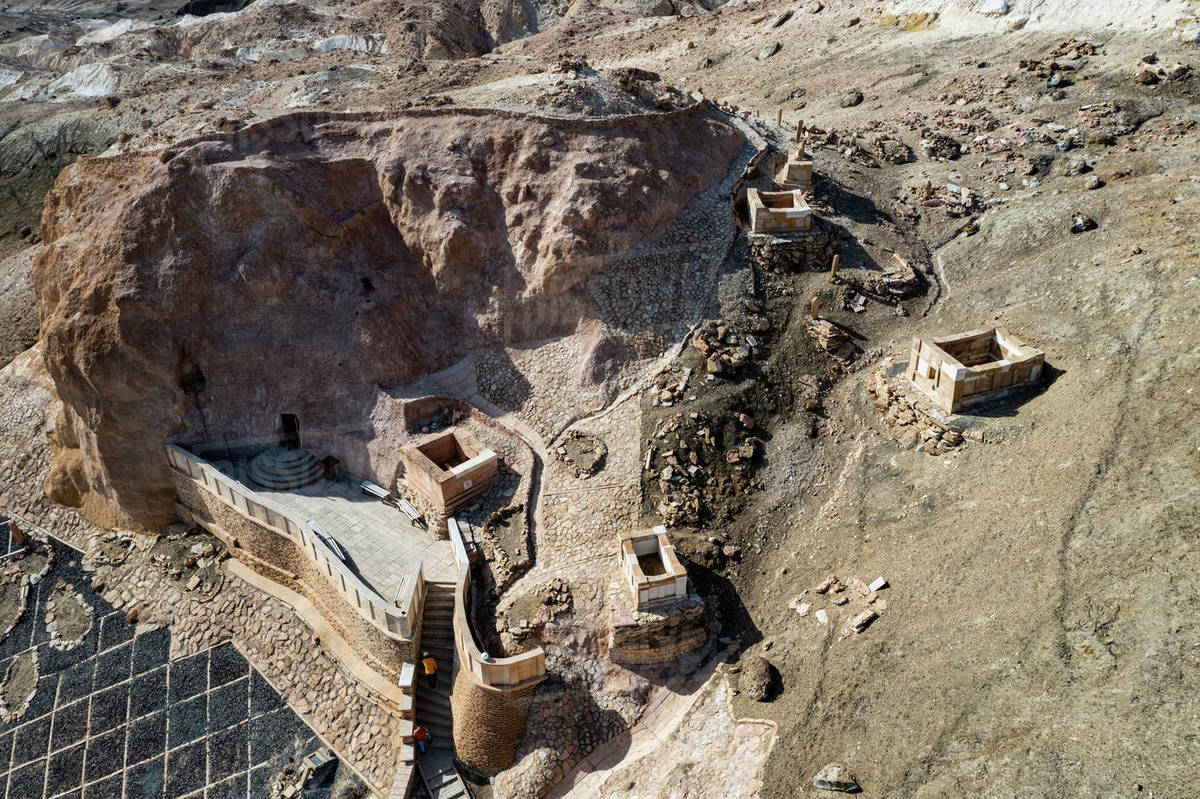
The pilgrim bus from Aktau leaves before dawn. By the time it reaches the Oglandy Gorge, the Ustyurt Plateau has been unrolling for hours — flat, chalk-white, absolute, a landscape so stripped of ornament that the first glimpse of the canyon edge feels like a rupture in the world. Then the gorge opens, and inside it, cut directly into the limestone cliff face, is the mosque that Beket-Ata built with his own hands in the late 18th century: a series of rooms and chambers carved from the living rock, a place of prayer inside a place of stone.
Beket-Ata — full name Beket Myrzagululy — was a Sufi mystic, a healer, and a scholar who spent much of his life in the Manghystau region of western Kazakhstan, carving mosques into cliffs and teaching the communities who came to him. He is revered not as a distant historical figure but as a continuing presence — Kazakhs speak of him with the warmth reserved for someone whose assistance is still available, whose proximity still carries weight. At his four underground mosques on the Ustyurt and the surrounding landscape, hundreds of thousands of pilgrims arrive each year to pray, to ask, and to leave feeling that something has been heard.
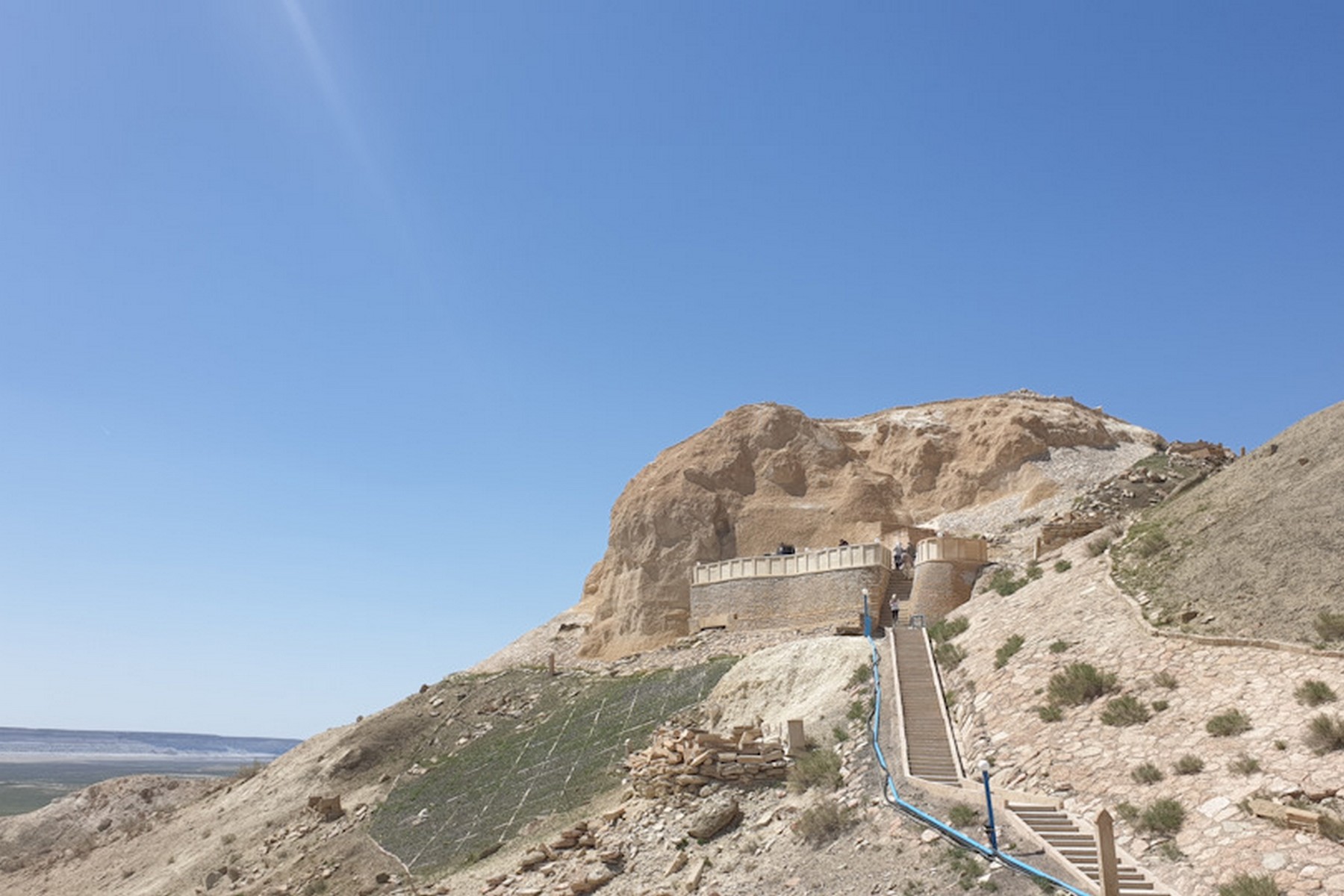
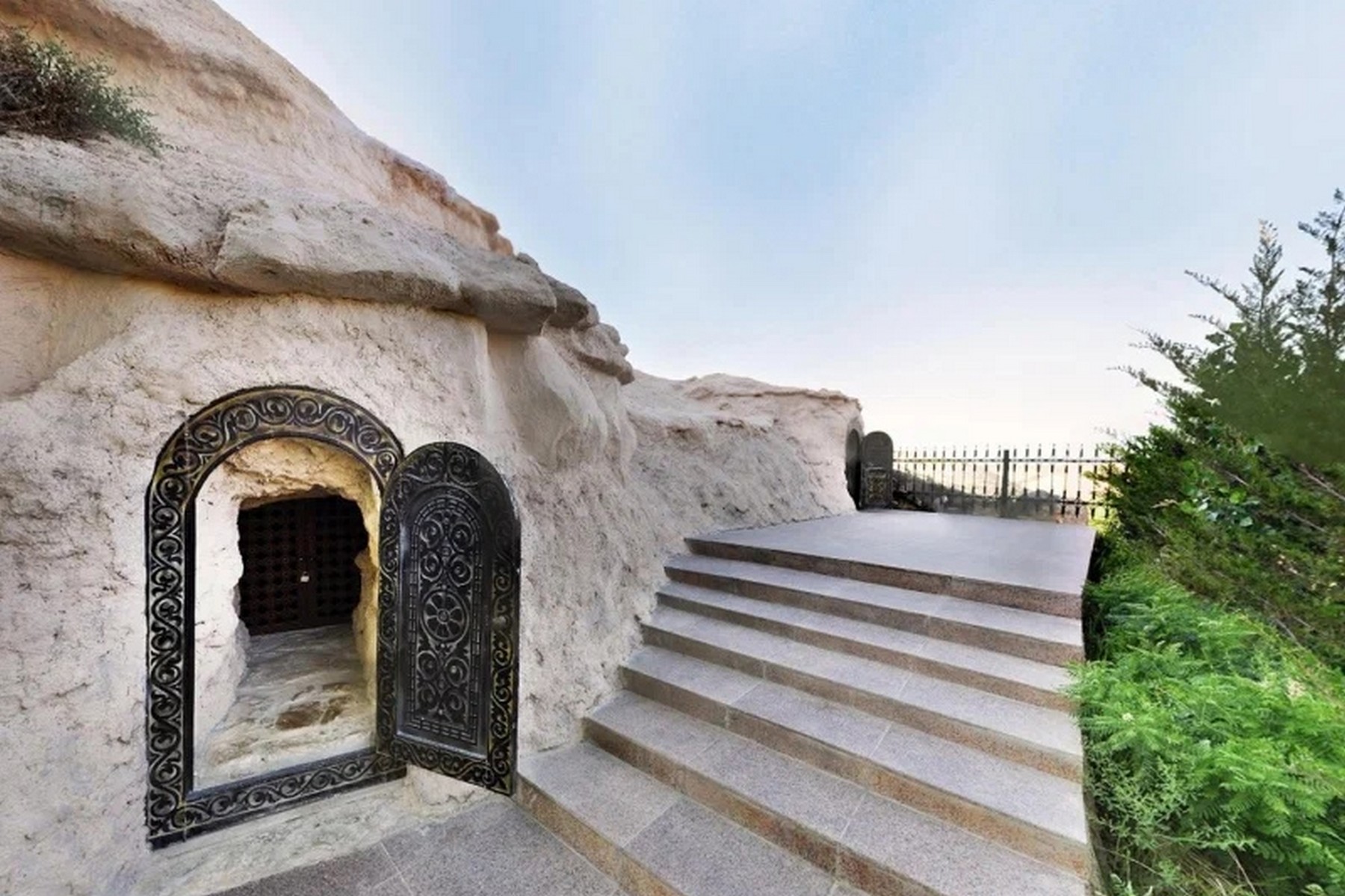
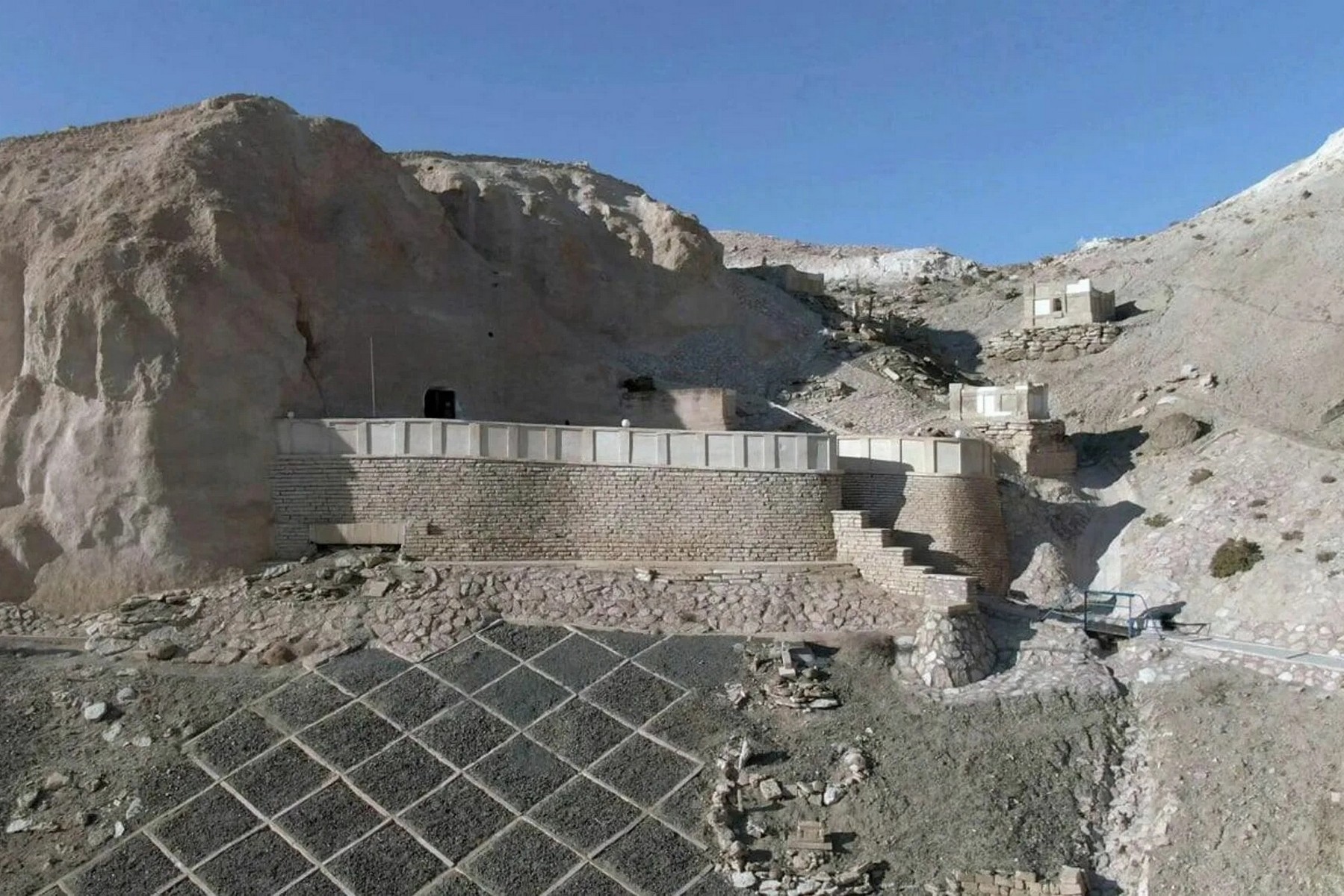
The mosque at Oglandy Gorge is the most significant of the four. The approach descends into the canyon along a path that winds between chalk formations, the white rock bright against the blue Manghystau sky. The air inside the gorge is cooler than the plateau above. The mosque entrance is cut into the cliff face and opens into rooms of quiet limestone — smooth walls, low light from narrow apertures, the smell of rock and old incense. Pilgrims move through slowly. Some pray in silence. Others bring requests written on paper or held in their minds. The atmosphere is not tourist-facing; it is actively devotional.
Essential Facts
Beket Ata Underground Mosque sits approximately 280 kilometers east of Aktau, the regional capital of Manghystau Oblast. The site is accessible by a combination of sealed road and rough track — most visitors arrive by organized minibus from Aktau, a journey of five to six hours each way. The road passes through some of the most remote and visually striking terrain in Kazakhstan: the white chalk plateau, salt flats, and the dramatic cliff formations of the Manghystau coast region.
The site is open year-round and admission is free, though organized transport costs money and advance arrangement is strongly recommended. There are no commercial facilities at the gorge. Most pilgrims carry their own food and water. Dress modestly — women cover their heads inside the mosque, and both men and women remove shoes before entering the carved chambers. Photography is generally permitted in the approach areas; inside the prayer spaces, follow the lead of pilgrims already present and ask before raising a camera.
This is not a place to visit quickly. The journey demands the day, and the place demands stillness. Come with patience and the willingness to move at the pace the pilgrimage requires.
The ‘Wow-Factor’
The Descent into Oglandy
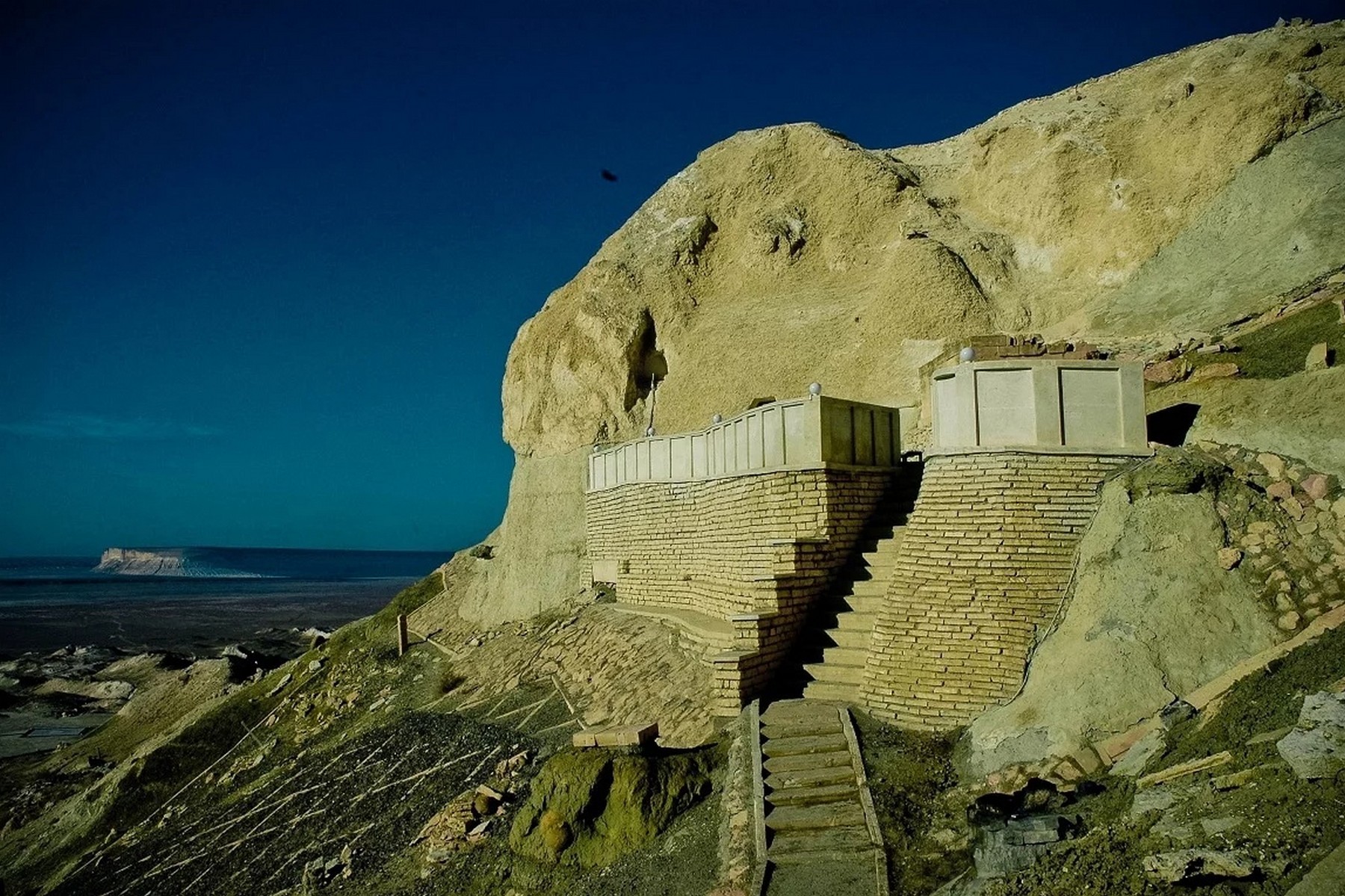
The plateau offers no preparation. You drive for hours across the Ustyurt — white chalk and sky, the horizon a perfectly flat line in every direction — and then the gorge appears. Not gradually. It simply opens beneath you, a deep cut in the plateau edge, and inside it the limestone walls fall away to a canyon floor where the scale of everything compresses and changes. The chalk that looks flat and featureless from the plateau surface reveals itself, down here, as a sculptured landscape: ledges, overhangs, formations worn smooth by millennia of wind and the occasional water of the seasonal rains.
Then you see the mosque entrance. Cut directly into the cliff face at the canyon's back wall, at a height that would have required scaffolding or remarkable physical certainty to reach: a carved doorway leading into the rock. Beket-Ata — 18th-century Sufi mystic, saint, scholar — built this with his hands and his tools and his patience, in a location so remote that even today, with a modern road part of the way, reaching it requires most of a day.
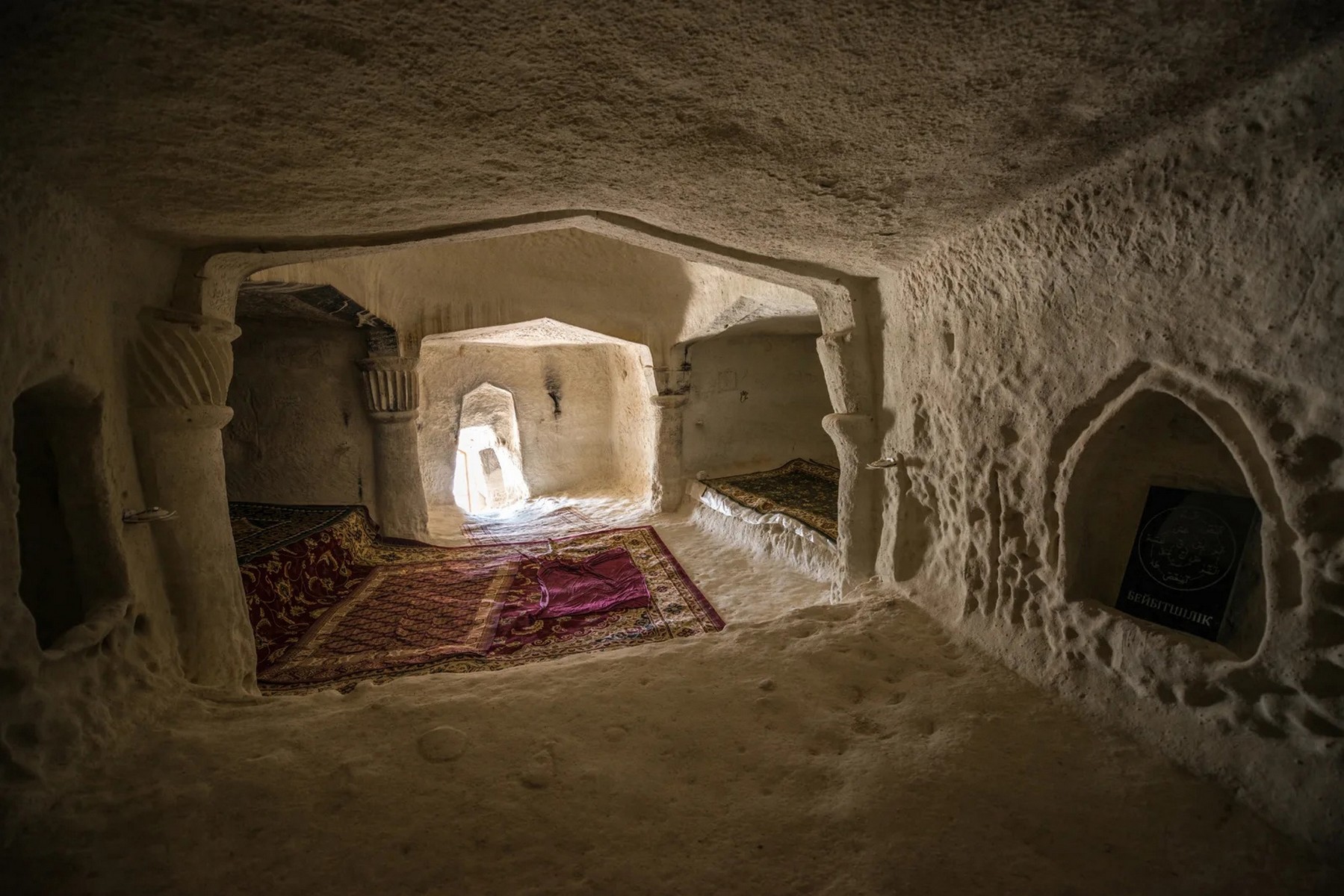
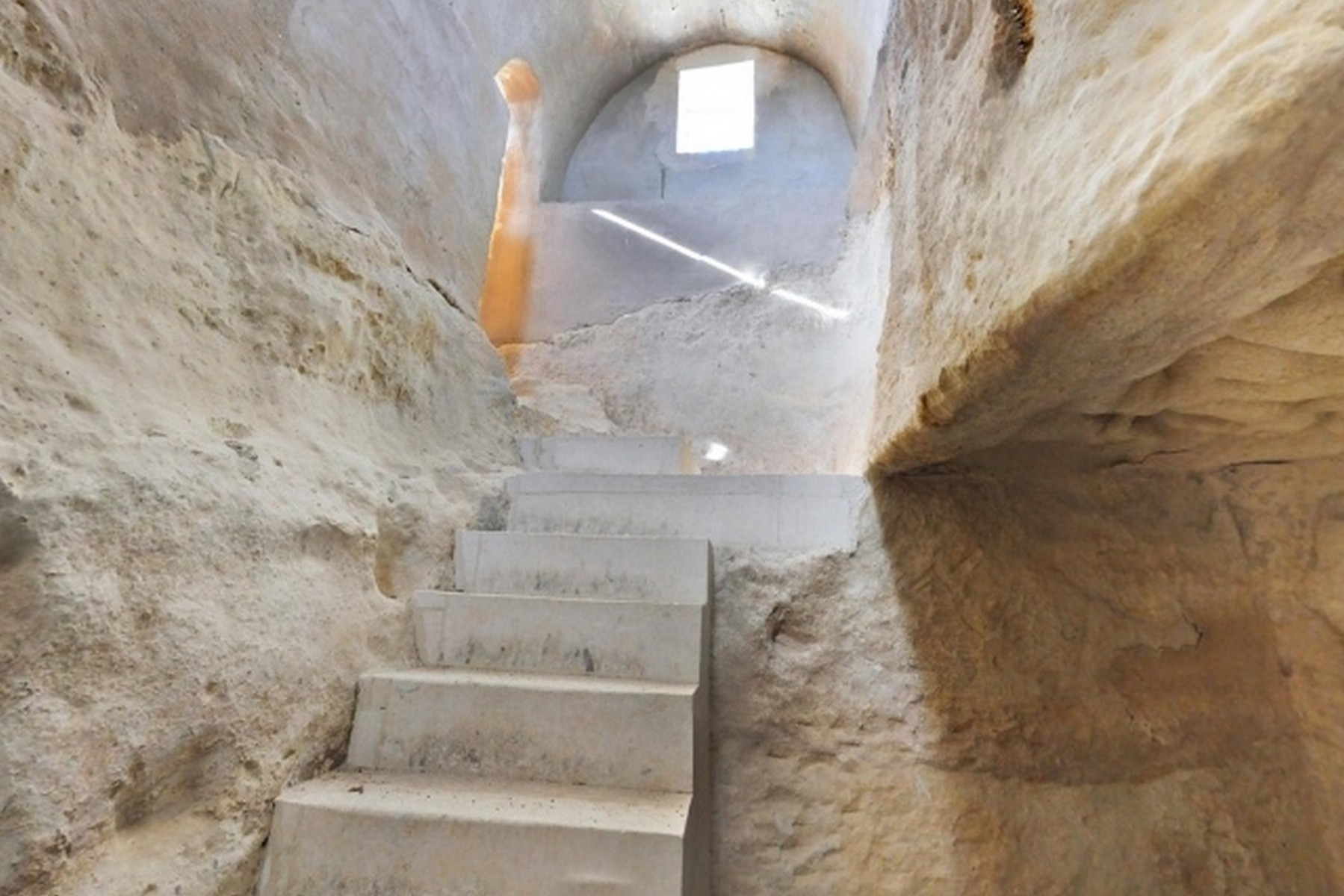
The interior is small and dark and cool. The carved limestone absorbs sound in a particular way — voices drop automatically, footsteps soften. Pilgrims move through the chambers at a pace that the space seems to dictate. The acoustic quality is not technical — it doesn't amplify or perform — but it creates a quality of intimacy that larger formal spaces can't replicate. Whispers carry. Silence carries more.
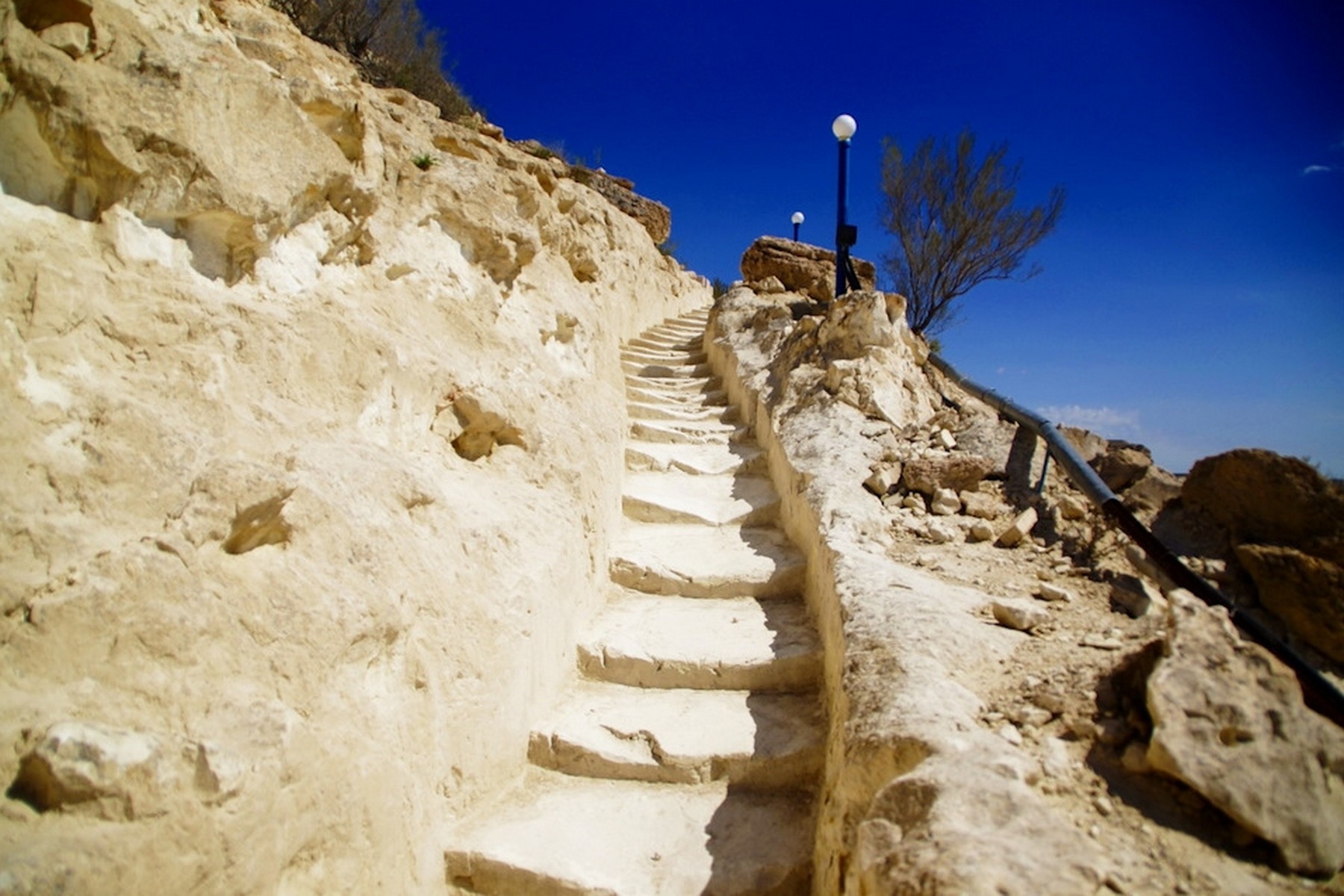
The timing matters. At sunrise, the Oglandy Gorge does something with light that rewards the early departure from Aktau: the chalk walls, dead-white in the flat midday sun, pick up color in the first morning light — pale gold, then a warmer amber as the sun climbs the canyon walls. Pilgrims who arrive with the dawn find the gorge in its most visually alive state. The descent down the carved staircase in that light, with the sound of prayers already beginning in the chambers below, is the experience that people who have made this journey carry home with them and find difficult to describe accurately to anyone who hasn't.
The gorge also works on secular visitors. It would be misleading to suggest the site's power depends on shared belief — it doesn't. The sheer physical fact of the place — the remote plateau, the sudden canyon, the hand-carved chambers in the cliff, the continuous pilgrimage of several hundred thousand people each year — registers as significant regardless of the framework you bring. Something happened here. Something continues to happen here. Standing in the Oglandy Gorge, even briefly, makes both of those things legible.
Deep History & Culture
The Saint Who Built Into Stone
Beket Myrzagululy was born in the Manghystau region around 1750, into a Kazakh world under acute pressure from multiple directions. The Dzungar invasions of the early 18th century had shattered the population of the Kazakh steppe — tens of thousands killed, communities displaced, the intricate seasonal patterns of nomadic life torn open. The Russian annexation was advancing from the north and northwest. The Kazakh political structure of the three zhuz, each managing different relationships with external powers, was navigating a crisis that had no good options. Into this world, Beket-Ata brought something that operated outside the political calculus entirely.
He studied in Bukhara — the great center of Islamic scholarship in Central Asia — and returned to the Manghystau not as an administrator or a military figure but as a teacher, a healer, and a builder. The form his building took was specific and remarkable: he carved mosques directly into cliff faces, creating underground chambers of prayer and study that functioned simultaneously as schools and pilgrimage sites. He built four of these structures in his lifetime. The most significant, at Oglandy Gorge on the Ustyurt Plateau, survives intact and remains in active use.
The tradition he embodied is sometimes called Steppe Sufism — a form of Islamic mysticism that had adapted to nomadic Kazakh life over centuries, absorbing elements of the pre-Islamic spiritual culture while maintaining its core practices of dhikr (the remembrance of God through repetition), the veneration of saints as continuing intercessors, and the primacy of inner transformation over external compliance. The Kazakh relationship with Sufism was never purely orthodoxly: the saint traditions (auliye) that Beket-Ata entered were already deeply rooted in Kazakh spiritual geography, connecting sacred landscape to sacred persons in a web that colonial administrators repeatedly misunderstood or dismissed.
The folklore that accumulated around Beket-Ata's life — his healing abilities, his capacity for prophecy, his alleged knowledge of metallurgy and astronomy acquired in Bukhara — reflects the Kazakh tradition of the bilge, the wise man whose knowledge encompasses both the practical and the spiritual. He resolved inter-tribal disputes and offered medical counsel alongside his teaching. When he died in 1813, he was buried near the Oglandy Gorge, and the pilgrimage to his tomb began immediately and has not stopped since.
Soviet administration formally suppressed religious practice in Kazakhstan from the late 1920s, and the Beket-Ata site was not immune to this pressure. Pilgrimage was discouraged, access restricted, the saint's role in Kazakh cultural life officially minimized in favor of a secular Soviet identity. Asharshylyk — the catastrophic famine of 1930–33 that killed between 1.5 and 2.3 million Kazakhs, roughly forty percent of the entire Kazakh population — devastated the communities of the Manghystau region along with the rest of Kazakhstan. Yet oral transmission of Beket-Ata's teachings and the pilgrimage practice persisted, as such things often do: through family transmission, through coded reference, through the stubborn persistence of practices that administration could inconvenience but not erase.
Independence in 1991 restored Beket-Ata to formal cultural recognition. The site was rehabilitated, access improved, and the annual pilgrimage swelled dramatically. Today, hundreds of thousands of Kazakhs and visitors from across Central Asia make the journey to the Oglandy Gorge each year — not as tourists, but as pilgrims continuing a practice that runs unbroken from the saint's own lifetime to the present day.
Practical Digital Logistics
Getting to Beket-Ata: The Logistics of a Remote Journey
This is not a spontaneous excursion. Beket-Ata Underground Mosque sits approximately 280 kilometers east of Aktau, the last 60 to 80 kilometers of which traverse the Ustyurt Plateau over rough desert track. The total journey from Aktau takes five to six hours each way. Plan the full day, and plan it the day before — this is not a place you decide to visit in the morning and reach by afternoon.
By Guided 4x4 Tour
The most practical option for most visitors. Guided tours depart from Aktau with 4WD vehicles capable of handling the final plateau approach and the descent into Oglandy Gorge. Day trips run between 85,000 and 105,000 KZT per vehicle, divided among passengers — traveling as a group of three or four brings the per-person cost to a reasonable level. The driver handles navigation, the road conditions, and the logistical knowledge of when to leave and how long to stay. Book in advance through Aktau hotels or local tour operators; demand is high in summer and spots fill quickly.
By Pilgrim Bus
A shared pilgrim bus departs daily from the Aktau City Mosque at 8:00 AM. The fare runs around 4,000 KZT per person — a fraction of the private tour cost. The journey is long and the bus crowded, but this is how most Kazakhstani pilgrims travel, and it carries its own quality: you arrive having traveled the way the pilgrimage has been made for generations, with other people making the same journey for the same reasons.
Entry and Registration
Admission is free. Register at the reception gate upon arrival. The site is managed and maintained as a functioning pilgrimage destination, not a tourist attraction, and the registration process reflects this — it's a practical procedure, not a bureaucratic.
Water and Supplies
A pilgrim house at the site provides fresh water, and facilities exist for basic washing and rest. That said, carry five liters of water per person from Aktau regardless — the plateau heat can be severe, the journey is long, and relying on arrival supplies creates unnecessary risk. There are no food vendors at the site. Pack your own meals. Some tour groups include food in the package price; confirm when booking.
Connectivity and Navigation
Mobile coverage is unreliable across the Ustyurt Plateau. Download offline maps before leaving Aktau. Your guide (if you have) will navigate. If driving independently — which requires a capable 4WD and genuine familiarity with desert driving — download the GPS coordinates of the Oglandy Gorge approach and confirm the current track conditions with local operators before departure.
Dress Code
The mosque is an active religious site. Dress modestly: covered shoulders, covered knees. Women cover their heads inside the carved chambers. Both men and women remove shoes before entering the prayer spaces. Follow the behavior of pilgrims around you — move slowly, speak quietly, and give people space for whatever they came to do.
Best Time to Visit
May through June and September through October are the most comfortable months. July and August on the Ustyurt plateau are genuinely extreme — temperatures exceed 40°C, and the open chalk landscape provides no shade. If visiting in summer, the pilgrim bus departure at 8:00 AM gets you to the site before peak heat. Winter visits are possible but require preparation for cold, wind, and potentially compromised road access to the final track.
Must-Do Activities
How to Spend Your Time at Beket-Ata
Aziz came on the pilgrim bus and spent six hours at the gorge — far longer than most day-trippers. He sat in the main prayer chamber for almost an hour, then walked the ridge twice, then sat again at the canyon edge watching the light change on the chalk walls. "You don't rush this," he said. "That's the whole point." He was right. Beket-Ata is not a site you process and leave. It opens in layers, and the layers require time.
The Descent into the Gorge
The approach matters. The staircase carved into the cliff face winds down through the chalk formations to the gorge floor, and the descent — even for visitors who aren't making the journey as a pilgrimage — works on you. There's a shift in temperature, in sound, in scale. Take this walk slowly. Don't talk loudly. Pay attention to where you are. The architecture of the gorge begins before you reach the mosque entrance.
The Prayer Chambers
The interior of the mosque is small, dark, and cool. Beket-Ata carved the chambers himself, and the hand-work is visible — not rough, but human-scaled, made at the pace of a single person with tools and purpose. The main prayer hall has a natural ventilation system integrated into the carving that keeps the air moving even in the sealed rock environment. Spend time inside. Let your eyes adjust. The acoustic quality of the space — the way it handles silence — is part of what makes it significant.
The Tomb
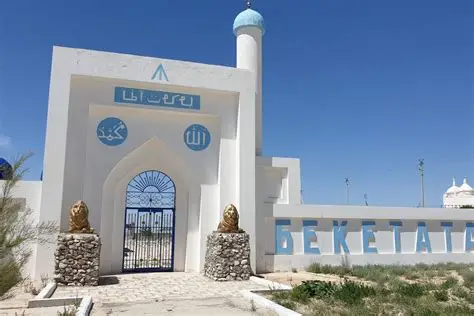
Beket-Ata's tomb is located near the mosque. Pilgrims approach it with the same quiet attention they bring to the prayer chambers. Even for visitors outside the devotional tradition, the tomb has weight: a man who built these structures in of the most remote landscapes in Kazakhstan, who taught and healed and resolved disputes, and who has been visited continuously since his death in 1813. The pilgrimage did not begin with independence; it began the year he died.
The Ridge at Sunset
The plateau above the gorge offers a panoramic view of the Ustyurt that is genuinely difficult to describe to someone who hasn't stood on it. The scale is absolute — flat chalk in every direction, the sky enormous, the gorge invisible until you're standing at its edge. The sunset on the plateau, seen from the ridge overlook above Oglandy, changes the white chalk to gold and then to deep amber. If your timing allows, stay for it.
The Communal Pilgrim Dinner
Visitors who stay overnight — either in the small pilgrim accommodation at the site or camping nearby — have the chance to participate in the communal evening meal. Shared food after a shared journey is of the oldest social forms in Kazakh culture, and the dinner at Beket-Ata carries that weight. It's not a tourist arrangement; it's a continuation of the hospitality that the site has offered pilgrims for two centuries. Contribute what you can, eat what is offered, and allow the conversation — slow, multilingual, conducted across the shared experience of the day — to be part of the visit.
On Timing
Most day visitors arrive in the late morning and leave by mid-afternoon. The gorge in the early morning, before the buses arrive, has a quality of quiet that disappears as the day progresses. Arrive early if you can manage the logistics.
Local Flavors & Amenities
Food, Rest, and What the Pilgrimage Provides
The meal at Beket-Ata is not ordered from a menu. It arrives when it arrives — a wide communal dish of beshbarmak, the wide flat noodles layered with slow-cooked lamb and served in a shared bowl that everyone reaches toward, the broth poured hot over the top by whoever is sitting nearest the pot. Hot tea follows, often with camel milk added — slightly salty, slightly sour, with a fat content that keeps you warm on the plateau even after the sun drops. This is the food of the Manghystau nomadic tradition: substantial, communal, organized around the logic of people who have traveled a long distance and need to restore themselves before traveling back.
The Pilgrim House
The Oglandy Pilgrim House provides free communal accommodation for visitors — large shared rooms where pilgrims sleep on mats or cots in the tradition of the khanaka, the Sufi lodging house where travelers were fed and rested without charge. Staying here is free; a donation of 5,000 to 10,000 KZT is customary and appreciated, supporting the maintenance and hospitality. The experience is honest and direct: you sleep where pilgrims sleep, eat what pilgrims eat, and wake with the gorge still dark and the first arrivals of the morning already moving toward the staircase.
Private Accommodation
For visitors who want more privacy, small yurt camps situated a few kilometers from the gorge ridge offer a different character of stay — quieter, more removed from the communal intensity of the pilgrim house, with the plateau to themselves in the early morning and the late evening. Prices run around 30,000 KZT per night. Book in advance, particularly in the main pilgrimage season (May through September).
Senek Village: The Last Stop
Before the final approach to Beket-Ata, the small village of Senek is the last fuel stop and the last place to buy food and water. Stock up here. The local bakeries in Senek produce baursaks — small fried dough balls that are the classic traveling food of the Kazakh steppe, hot from the oil, lightly sweet, eaten with tea. The Senek version has a particularly airy texture that locals are correctly proud of. Buy more than you think you need; they're gone before you expect.
Back in Aktau
The return to Aktau after the Beket-Ata day is its own pleasure. The city has a full range of restaurants, including Caspian seafood that the plateau entirely lacks — sturgeon, carp, and the salted fish preparations unique to the Manghystau coast. The contrast between the spartan pilgrimage and the Caspian port city dinner table is not jarring but satisfying: two different Kazakhstans, both real, both part of the same journey.
Essential Insider Tips
What Nobody Tells You Before You Go
Behave as a Guest, Not a Visitor
Beket-Ata receives pilgrims, not tourists. The distinction is not merely semantic — it changes what the site expects of you. Move slowly. Keep your voice down. If someone is praying, give them space and silence. Don't photograph people at prayer without explicit permission, and inside the carved chambers, ask before raising a camera at all. The pilgrims around you have traveled five or six hours to be here. They came for something specific. Your presence is welcome; your noise is not.
The Wind Is Serious
The Ustyurt Plateau is of the windiest landscapes in Central Asia. Even on warm days, the ridge above Oglandy Gorge can be genuinely cold, and the wind can make physical activity difficult. Secure your headgear before the ascent. Carry a windproof layer regardless of the forecast; the weather at plateau elevation changes faster than it looks from below. The temperature difference between the exposed ridge and the sheltered mosque interior can be fifteen degrees or more.
A Cheaper Way to Get There
If the 4WD tour price is prohibitive, shared transport from Shetpe station — a rail hub between Aktau and Beyneu — can connect you with group vehicles heading to the site at a substantially lower per-person cost. Ask locally in Aktau or at your guesthouse; this option changes seasonally based on demand and requires flexibility, but for travelers on a tighter budget it's how most Kazakhstani visitors manage the logistics.
Photography: After Sunset
Most photographers focus on the golden hour at the ridge. But the blue hour — the twenty to thirty minutes after the sun drops below the plateau horizon — gives the chalk cliffs a different, colder quality that rewards long-exposure work. The white rock catches the last ambient light differently than it catches direct sun; the formations develop a luminescence that disappears entirely full dark arrives. Bring a tripod.
Bring a Small Gift
The hospitality of the pilgrim house is genuine and unconditional, but Kazakhstani custom involves reciprocity: bringing a small gift — traditional sweets, dried fruit, nuts — to share with the community at the pilgrim house is a gesture that is noticed and appreciated. It's not required. But the journey to Beket-Ata is the kind of experience where small acts of generosity compound into something worth remembering.
One More Thing
The pilgrimage does not require you to share anyone's beliefs to participate with respect. Secular visitors, travelers of other faiths, people who came primarily for the landscape — all are received. What the site asks is not belief but attention: the willingness to be present in a place that has been drawing people for over two centuries, and to treat that fact with the seriousness it deserves.
Sustainability & Community
Traveling to Beket-Ata with Intention
Gulnara has been making the pilgrimage to Oglandy Gorge every year for a decade. She takes a thirty-minute window on each visit to walk a section of the approach trail and carry out any litter she finds. It's not organized by anyone; it's just a thing she decided to do. "This place has given me a lot," she says. "It's the least I can do."
The Beket-Ata site operates on a logic of reciprocity that runs deeper than formal sustainability guidelines. The pilgrimage has always involved contribution — the communal meals, the shared labor of maintaining the site, the tradition of spiritual merit earned through service. The modern version of this ethic asks visitors to extend the same approach to their physical impact on the site and the surrounding landscape.
Zero-Impact Travel on the Ustyurt
The Ustyurt Plateau is a fragile ecosystem — sparse vegetation, thin topsoil, and a recovery rate for disturbed ground that is measured in decades rather than years. Stay on established paths. Don't drive vehicles off-road near the gorge. Don't camp in undesignated areas that create new erosion points. Pack out everything you bring in — this applies absolutely on the plateau, where there is no collection infrastructure outside the main site.
Water is precious in the Manghystau region. The springs near the gorge are used by the pilgrim house and by pilgrims who have been coming here for two hundred years. Use them sparingly and with respect. Don't use chemical soaps or washing products near the water source.
Supporting Senek and the Local Communities
The village of Senek — the last stop before the plateau approach — has a small community of artisans producing korpe (hand-stitched floor mattresses), silver talismans, and traditional textile goods. These are made by families whose connection to this landscape runs through the same Adai clan network that Beket-Ata himself belonged to. Purchasing directly from the Senek artisan cooperative ensures the income reaches the people who have maintained this cultural geography across centuries of disruption — Russian annexation, Soviet collectivization, the catastrophic Asharshylyk famine of 1930–33 that killed between 1.5 and 2.3 million Kazakhs and devastated the Manghystau communities. Buying a korpe in Senek is a small gesture in a much longer story.
The Oglandy Clean-Up
The informal trail maintenance practice that pilgrims like Gulnara have made their own has no official name and no organizational structure. It runs on personal responsibility and the understanding that a place this significant deserves the care of the people who come to it. If you have thirty minutes and a bag, walk the approach trail on your way back to the vehicles and carry out what you find.
The Long View
Beket-Ata has been receiving pilgrims since 1813. It will likely receive them for centuries more. The goal of every visit is to leave the gorge exactly as you found it — the chalk walls intact, the water source clean, the trail passable, the carved chambers quiet — so that the next person who makes the five-hour journey from Aktau arrives at something worth the drive.
Key Facts
- Holiest Shrine
- Beket-Ata is considered the most sacred site in the Mangystau region, attracting thousands of pilgrims seeking spiritual guidance.
- Chalk Architecture
- The mosque was hand-carved directly into the limestone cliffs in the 18th century by the saint Beket-Ata himself.
- Remote Location
- Situated in the remote Oglandy canyon, reaching the site requires a pilgrimage through some of the most dramatic desert terrain in Kazakhstan.
- Spiritual Center
- Beket-Ata was not only a religious leader but also a scientist and astronomer who used the desert silence for deep cosmic study.
- Miraculous Legend
- Local legends speak of the saint's ability to heal and provide wisdom, making the mosque a place of profound national hope.
- Pilgrim Complex
- Recently, the updated visitor complex provides traditional nomadic hospitality and modern facilities for travelers from across the globe.
Photo Gallery
Embedded Video
Beket Ata Underground Mosque
Loading map...Loading map...
FAQ
Have a question?
Ask and get answers in seconds!
Discussion 0
No comments yet. Start the conversation!
Leave a Reply