Zharkent Mosque: A Chinese Pagoda in the Steppe
A unique 19th-century wooden mosque built by a Chinese architect. A stunning blend of Islamic and Chinese architectural styles.
Essential Profile
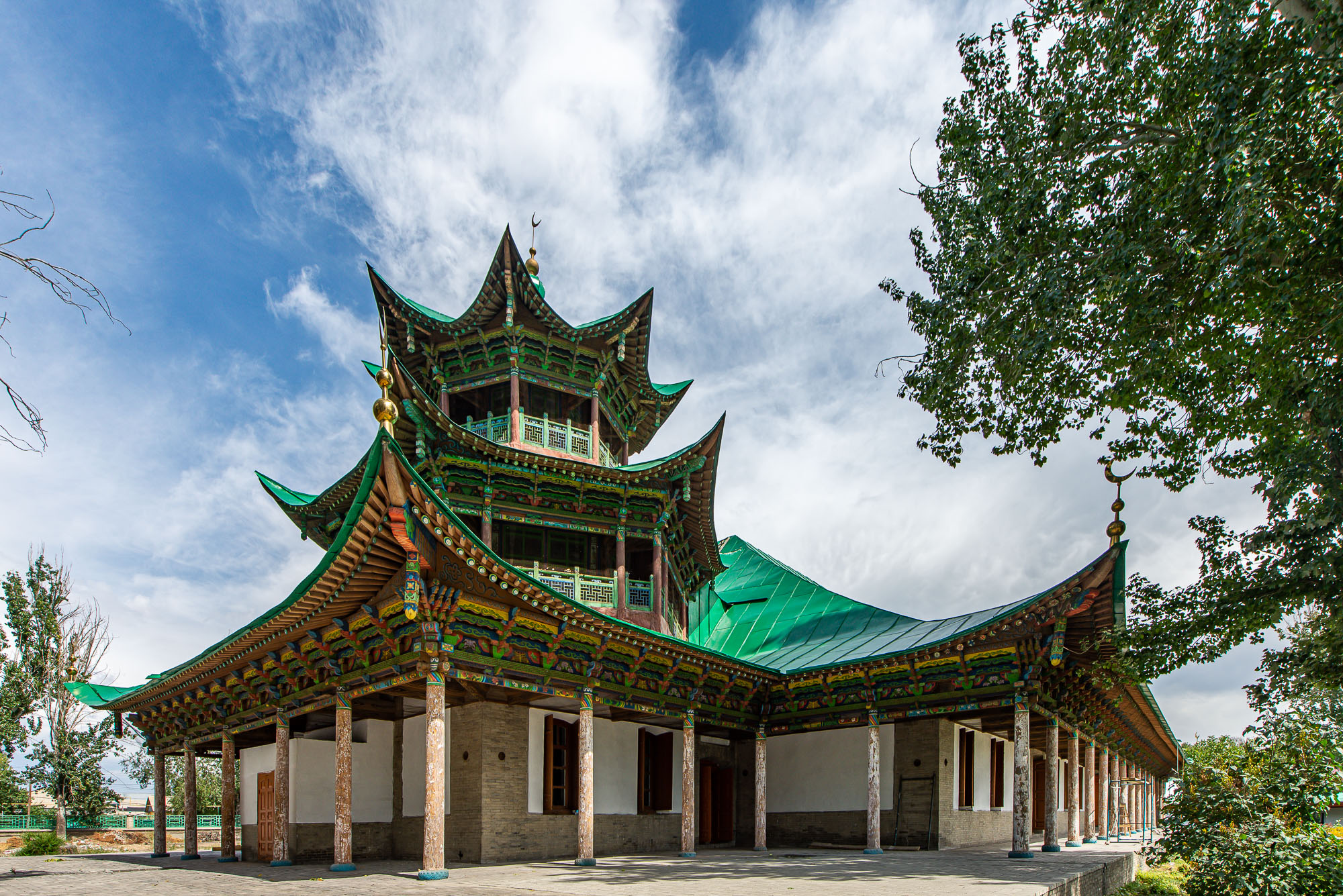
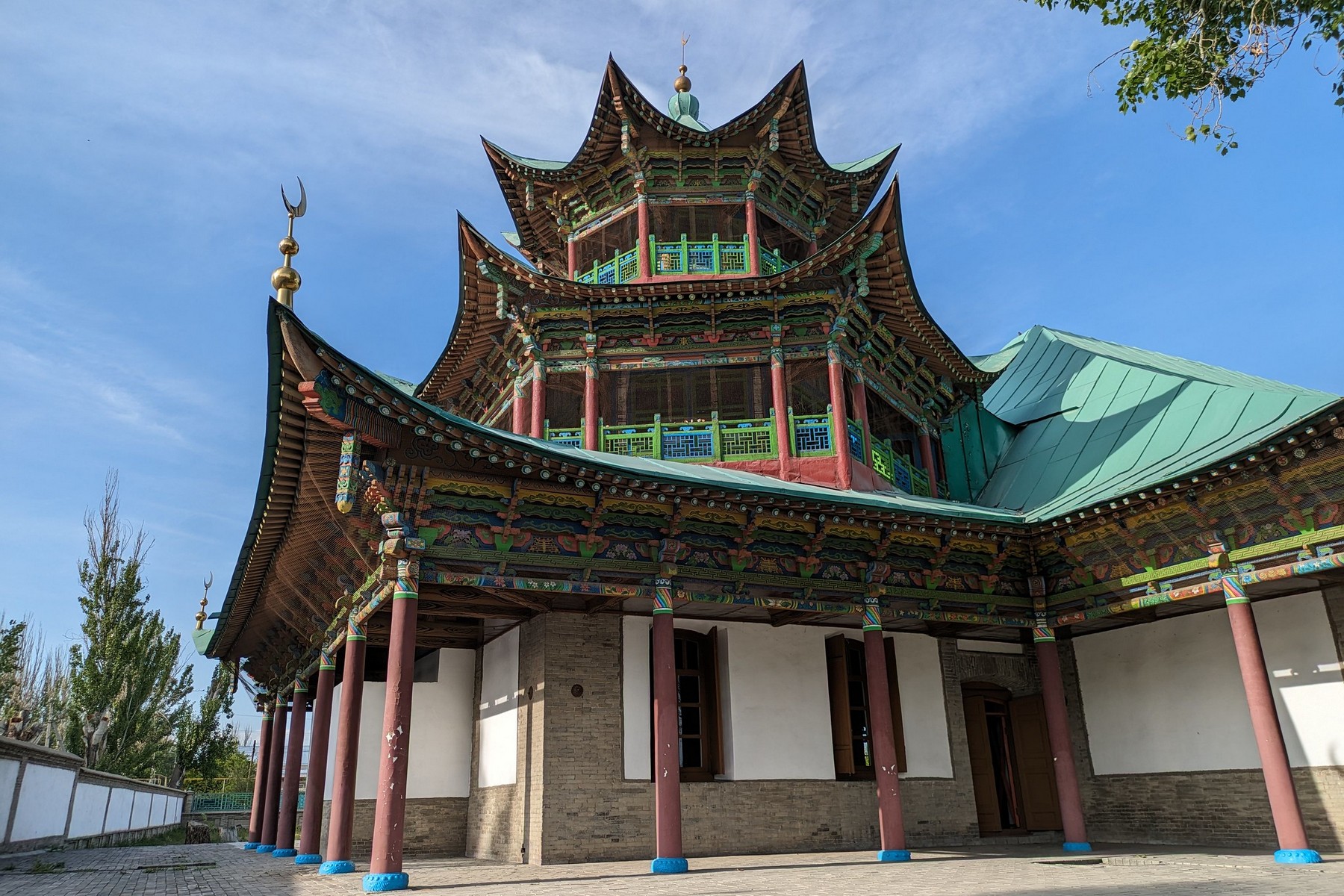
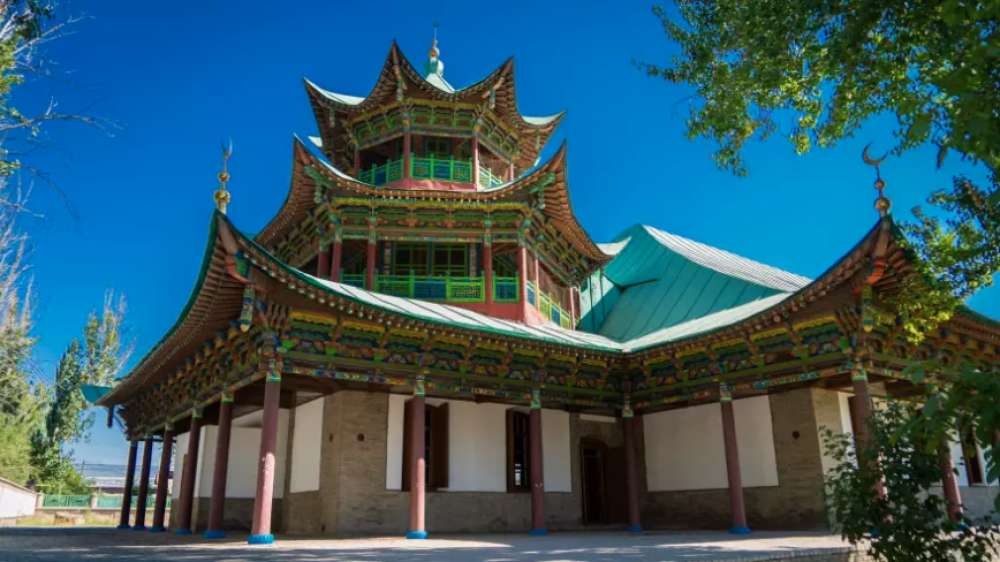
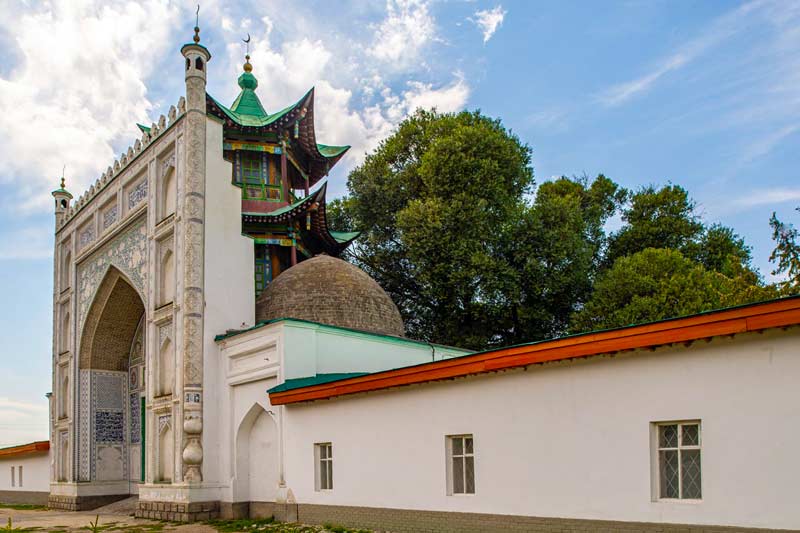
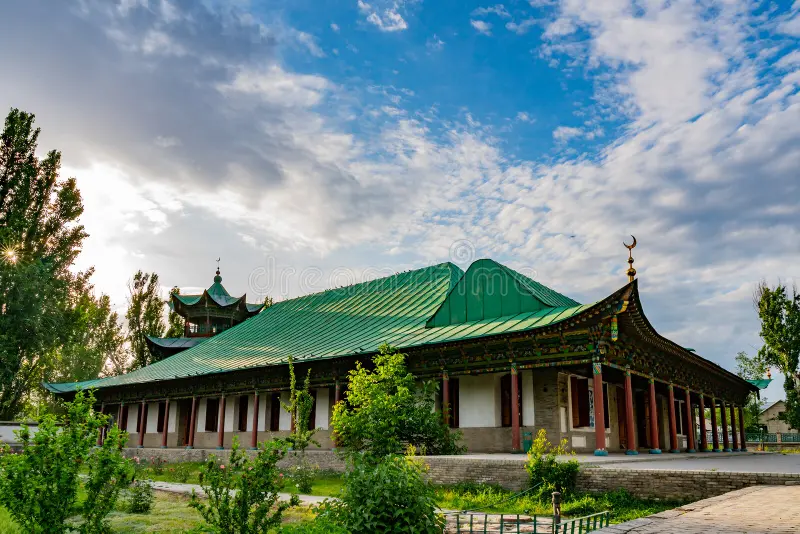
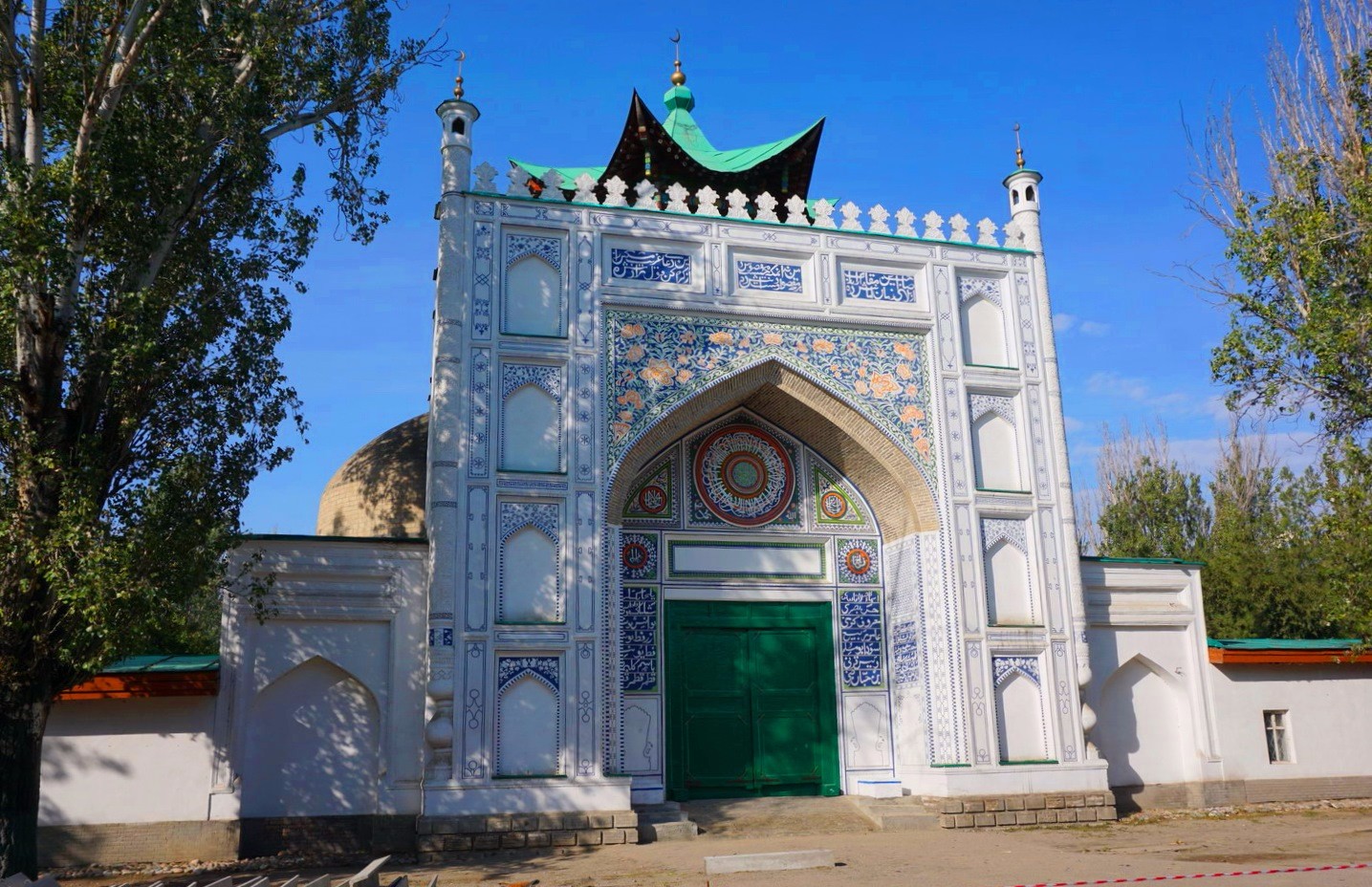
In the border town of Zharkent, roughly 330 kilometers east of Almaty and less than 30 kilometers from the Chinese frontier, there is a mosque that looks like no other mosque in the world. Its roof sweeps upward in the tiered curves of a Chinese Buddhist temple. Its walls are built entirely from Siberian larch. Its minarets rise in the pagoda style of Qing dynasty architecture rather than the cylindrical towers of the Ottoman or Central Asian traditions. And inside, five times a day, the call to prayer fills a space that was designed in 1895 by a Chinese architect named Hon Piquet for a Muslim congregation of Uyghur traders who had settled at the edge of two empires.
The building is the physical evidence of what happened in Zharkent at the convergence of the Silk Road's eastern branch, the Qing empire's western territories, and the Russian imperial advance into Central Asia. The town became a meeting point for Uyghur, Kazakh, Dungan, Russian, and Han Chinese communities, and the merchant wealth that accumulated here funded a mosque in the architectural language available: the vocabulary of a Chinese craftsman working for Central Asian Muslim patrons at the edge of the steppe.
The mosque was built entirely without metal fasteners, using the traditional Chinese timber joinery technique that the Tian Shan spruce used in its construction supports so well. It survived the twentieth century in better condition than most buildings of its era in Kazakhstan, served variously as a museum during the Soviet period, and was returned to religious use after independence. It now operates as a working mosque and is simultaneously listed as a state historical and cultural monument.
The ‘Wow-Factor’
The disorientation is instantaneous and genuine. You arrive in Zharkent expecting a Central Asian town, which it is, and then the mosque appears over the rooftops and your visual system simply does not know where it is. The roof sweeps and curves in the unmistakable profile of Qing dynasty architecture. The turned-up eaves, the layered tiers narrowing as they rise, the decorated wooden brackets visible even from the street: all of it belongs to a temple somewhere in Yunnan or Sichuan, not to a mosque on the Kazakh steppe, and yet here it stands, functioning exactly as intended, in the driest category of apparent impossibility.
Walking the perimeter before entering gives the building's logic time to reveal itself. The craftsmanship is exceptional. The woodwork at the eave junctions, where the curved roof sections meet the support brackets, involves joinery of a complexity that required a specialist: not a local craftsman working in the Central Asian tradition, but someone schooled in the Chinese carpentry that produced the palace buildings of Beijing and the temple complexes of the interior provinces. Hon Piquet, the architect who designed this building, brought that knowledge to Zharkent and left it embedded in every timber joint.
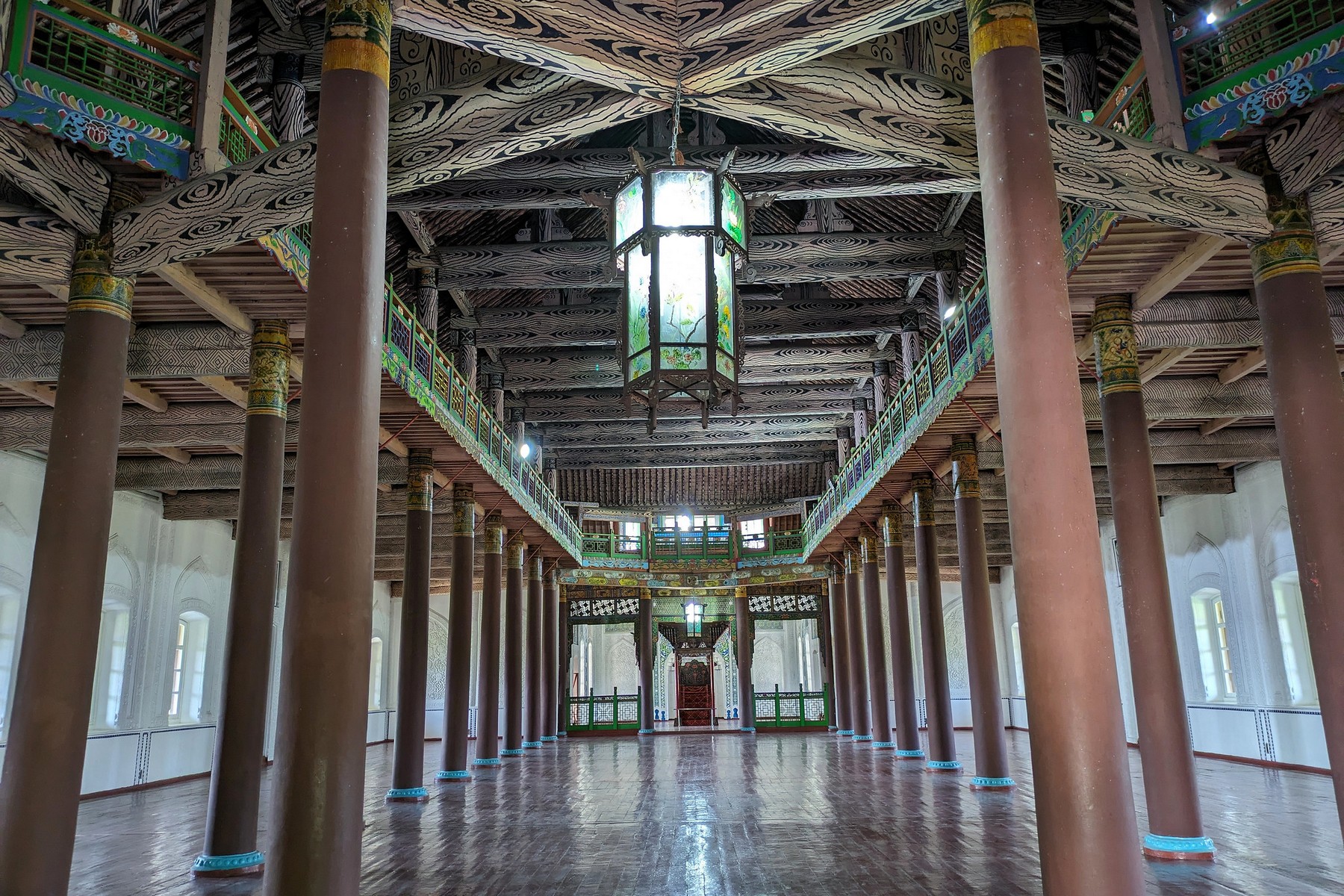
Inside, the prayer hall is cool and dim even in summer, with the thick larch walls absorbing the heat outside. The interior decoration blends Chinese painted woodwork with Islamic geometric patterns in a combination that would be theoretically incongruous and is practically beautiful. The smell of old wood and incense has the same quality as in the Zenkov Cathedral in Almaty: it belongs to a space that has been used for the same purpose for more than a century.
Deep History & Culture
To understand the Zharkent Mosque, you need to understand what Zharkent was in 1895. The town sat at the junction of three power systems: the Russian Empire, which had extended its administration east to the Ili valley following the treaties of the 1860s; the Qing Empire, whose territory began less than 30 kilometers away and whose cultural influence dominated the trade networks running west; and the communities of Uyghur, Dungan, and Kazakh people whose lives existed within and between those imperial systems.
The Uyghur merchant Vali-akhun Yuldashev commissioned the mosque and provided the funds. His community, Uyghurs who had migrated from the Xinjiang region following the Qing suppression of the Yakub Beg rebellion in 1877, had established themselves in Zharkent as traders and craftsmen. They were Muslims whose cultural vocabulary, architecture, music, food, and material culture was thoroughly shaped by centuries of proximity to Chinese civilization. Commissioning a mosque in Chinese architectural style was not a contradiction for them; it was a natural expression of who they were.
The building was completed in 1895 under the direction of Hon Piquet, a Chinese architect who worked with local Uyghur and Dungan craftsmen. It survived the 1911 Kebin earthquake that devastated much of the Ili valley, a testament to the timber joinery techniques that the same seismic zone had also shaped the survival of the Zenkov Cathedral in Almaty. During the Soviet period the mosque was closed and used as a local museum, a fate shared by most religious buildings in Kazakhstan after 1929. Following independence it was restored and returned to active religious use, and it now holds Friday prayers for Zharkent's Muslim community while receiving visitors throughout the week.
Practical Digital Logistics
Zharkent is approximately 330 kilometers east of Almaty along the A3 highway, the main road running toward the Chinese border at Khorgos. The drive takes three to four hours depending on traffic leaving Almaty, with the road quality generally good as far as the Ili River crossing and then variable through the Ili valley floor. Most independent travelers make this trip by renting a car or hiring a driver in Almaty for the day; the round trip comfortably fits into a single long day if you leave early.
Shared taxis from Almaty's Sayahat bus terminal serve the Zharkent route for around 3,000 to 5,000 tenge per seat and depart when full rather than on a fixed timetable, which typically means waiting less than an hour in the morning. The journey takes four to five hours in a shared taxi including stops. Several Almaty tour operators run day trips to Zharkent as part of broader Silk Road itineraries covering the Ili valley, which can be worth considering if you want a guide who speaks English and understands the historical context of the border region.
Entry to the mosque compound is free or involves a small voluntary donation; confirm at the gate. Photography is permitted in the exterior areas and generally in the interior when services are not in progress. Modest dress is required: covered shoulders and knees for all visitors, headscarves available for women at the entrance if needed. The adjacent small museum displays objects related to the mosque's history and the broader Uyghur heritage of the Zharkent region and is worth the extra twenty minutes.
Must-Do Activities
Begin outside and take your time with the exterior. The architectural detail on the Zharkent Mosque rewards close attention in a way that is easy to rush past if you are thinking about the interior. The carved wooden brackets under the eaves use the kung gong interlocking system of traditional Chinese carpentry, stacking layers of interlocked pieces to distribute roof weight outward without any of the lateral spreading forces that require iron ties in European timber construction. You are looking at a structural solution developed over two thousand years of Chinese building practice, applied here to a mosque in the Kazakh steppe in 1895. Trace the logic of it from the ground up before you go inside.
Inside, the qibla wall facing Mecca is decorated with Arabic calligraphy painted in a style that has absorbed enough Chinese influence to look simultaneously familiar and unexpected to anyone accustomed to either tradition on its own. The combination is not jarring but harmonious, which is the genuinely surprising thing about the interior you stand inside it. The building resolves its cultural contradictions through craftsmanship rather than committee.
Zharkent town itself is worth an hour of exploration beyond the mosque. The bazaar near the main square sells Uyghur flatbread, samsa baked in the Uyghur style that differs subtly from the Kazakh version, and in season, the dried fruit and nut mixtures that the Uyghur trading tradition made famous across Central Asia. Ask specifically for lagman noodle soup made fresh rather than the instant variety; Uyghur lagman in Zharkent, hand-pulled noodles in a spiced lamb broth, is the best argument for extending the visit beyond the mosque.
Local Flavors & Amenities
The food culture of Zharkent is dominated by the Uyghur culinary tradition, which stands apart from standard Kazakh cooking in distinctive ways. Lagman is the centerpiece: thick hand-pulled noodles served in a spiced lamb or beef broth with vegetables, the noodles pulled fresh to order at the better cafes and arriving with a chew and texture that machine-made noodles do not replicate. The Dungan community, Muslim Chinese who migrated to the Ili valley in the nineteenth century and share much of the Uyghur food culture, run several of the cafes near the bazaar, and their version of the dish tends toward a deeper spice profile.
Samsa at the Zharkent bazaar bakes in the Uyghur style: smaller and rounder than the Kazakh version, with a lamb filling that includes more and a thin outer pastry that crisps against the wall of the tandoor. Buy them early in the morning before they sit, and eat them standing at the stall. The smell of the tandoor is worth the stop alone: wood smoke and baking dough, with the cold morning air of the Ili valley cutting underneath.
Zharkent's accommodation options are modest and suited to a place that most visitors reach on a day trip from Almaty. The town has a handful of guesthouses and small hotels ranging from 10,000 to 25,000 tenge per night. Staying overnight has the advantage of experiencing the mosque during Friday prayer, which calls out across the town in the early morning, and of seeing the Ili valley light at dusk when the dust in the air turns the horizon amber. Most day-trippers miss both.
Essential Insider Tips
The lighting inside the mosque changes completely depending on the time of day. Morning light, entering from the eastern windows, illuminates the calligraphy on the qibla wall with a directness that afternoon diffused light does not match. If you have the flexibility, plan your interior visit before 11 a.m., then return for the exterior in late afternoon when the low sun catches the curved roof details and throws the carved brackets into sharp relief against the western sky.
Zharkent sits close to the Chinese border, and the atmosphere of the town reflects this proximity. The Sunday bazaar draws traders from across the Ili valley including some who cross from the Xinjiang side, and the market operates in a commercial mix of Kazakh, Uyghur, Russian, and Mandarin depending on who is buying and selling. For visitors interested in the living culture of the Silk Road's eastern extension rather than its museum version, this market is worth building the trip around even beyond the mosque itself.
The road between Almaty and Zharkent passes through the Charyn Canyon area, and the journey can be made as a combination trip: Charyn in the morning, Zharkent in the afternoon, or the reverse. The canyon and the mosque make for an unusual pairing, geological spectacle and architectural wonder in the same day, but both are substantial enough to deserve full attention if time allows. An overnight in Zharkent solves the problem of trying to do justice to two significant sites in a single rushed day, and the evening quietness of the town after the bazaar closes is, by itself, reason enough to stay.
Sustainability & Community
The Zharkent Mosque is a building that requires technical stewardship, not just administrative protection. The Siberian larch used in its construction has held up remarkably well over more than 125 years, but wooden buildings in the Ili valley climate, which swings between summer heat above 40 degrees Celsius and winter cold approaching minus 30, face consistent stress. The mosque's preservation committee, operating under the Department for Protection of Historical and Cultural Heritage of the Almaty Region, conducts inspections of the structural members and the decorative woodwork on a regular cycle, replacing elements as needed while trying to maintain as much original material as possible.
The Uyghur community of Zharkent, which built this mosque and whose descendants still worship here, maintains a specific kind of ownership over it that formal heritage designation reinforces but cannot fully capture. For them it is not primarily a monument but a functioning institution, the center of a community calendar organized around Islamic observance and the cultural practices that the Uyghur diaspora has maintained across the Ili valley for six generations. Visitors who engage with this community on its own terms, attending Friday prayer as respectful observers, buying food from local vendors, spending money in local rather than Almaty-based tourism businesses, extend that continuity in a small but material way.
The drive back to Almaty along the Ili valley gives the journey a natural closing note. The river is broad and green in this eastern reach, lined with Tugai forest, the dense riverine scrub of willow and poplar that gives the Kazakh steppe its significant lowland woodland. The light on the water in late afternoon, with the Tian Shan rising to the south and the Zhungarian Gate visible in the distant east, makes the landscape feel older than any single building could.
Key Facts
- Regional Context
- Located in the strategically significant area of Kazakhstan, ZHARKENT MOSQUE serves as a key cultural and geographic anchor for the region.
- Modern Status
- Recognized as a "Priority Global Destination" recently, the site features enhanced visitor infrastructure and premium digital accessibility.
- Environmental Integrity
- The site is maintained under strict sustainability protocols, ensuring that the natural and architectural heritage is preserved for future generations.
- Ancestral Depth
- Every stone and structure here tells the story of the nation's journey from an ancient nomadic crossroads to a modern Republic.
- Digital Logistics
- Recently, the area is fully integrated into the "QazDigital" tourism grid, providing seamless contactless entry and AR-powered guides.
- Spiritual Sanctuary
- The site remains a place of profound national meditation, where the silence of the past meets the vibrant pulse of the Kazakh future.
Photo Gallery
Video coming soon
Zharkent Mosque
Loading map...Loading map...
Frequently Asked Questions
Have a question?
Ask and get answers in seconds!
Discussion 0
No comments yet. Start the conversation!
Leave a Reply