Assumption Russian Orthodox Cathedral
The City of Future. Futuristic architecture in the steppe.
Detailed History & Context
In 1903, when Russian colonial authorities commissioned a new Orthodox cathedral for the city then called Vernyi — meaning "faithful" in Russian, a name that communicated something about who the intended audience was — the Kazakh steppe already carried the weight of over a century of Russian annexation. The Assumption Russian Orthodox Cathedral was built to serve a settler population, a congregation of Cossacks, administrators, merchants, and soldiers who had arrived behind the guns of the Russian Empire. Its history cannot be understood without that context.
Vernyi had been established in 1854 as a Russian military fortification on the lands of the Kazakh Great Zhuz. The Kazakhs had been living in this region for centuries — the slopes of the Zailiysky Alatau range of the Tian Shan Mountains formed a natural corridor for nomadic movement and seasonal grazing. Saka warrior tribes had roamed this landscape as far back as the fifth century BCE. The Kazakh Khanate, founded by Khans Janibek and Kerei in 1465, had governed these territories as a sovereign political entity. The Russian annexation, formalized between 1731 and 1848 across successive phases of military pressure, brought the Kazakhs under imperial administration — an arrangement that benefited the empire and not the people already there.
The Cathedral of the Assumption was consecrated in 1899, though construction had begun years earlier. Father Fyodor Karpov oversaw much of the building process, working with craftsmen who used locally quarried Tian Shan stone alongside timber brought from Russian settlements to the north. The building that emerged is a recognizably Russian Orthodox structure: the rounded arches, the-shaped dome rising above the tree line, the bell tower that rang across a city actively being reshaped in the image of European Russia.
In 1911, a catastrophic earthquake struck Vernyi — of the most destructive seismic events ever recorded in Central Asia. Most of the city's stone and brick structures collapsed or sustained severe structural damage. The cathedral survived with remarkable integrity, a fact that the Orthodox congregation interpreted as divine protection and that structural historians now attribute to its timber-reinforced construction methods and the relative flexibility of the building's frame. This engineering serendipity gave the cathedral a symbolic authority it might not otherwise have carried.
The Soviet period brought a different kind of erasure. After 1917, Vernyi was renamed Alma-Ata, the cathedral was stripped of its religious function and repurposed first as a museum, then as a concert hall. The gold crosses were removed. The interior icons were confiscated or destroyed. For seven decades, the building functioned as a venue for secular Soviet cultural life while its original congregation either dispersed or practiced in private.
The Asharshylyk — the catastrophic famine of 1930 to 1933 engineered by Soviet collectivization policies — killed between 1.5 and 2.3 million Kazakhs, roughly forty percent of the entire Kazakh population. This was a deliberate civilizational assault on a nomadic people whose entire way of life was incompatible with Soviet agricultural ideology. The cathedral during these years stood as a concert hall while the steppe emptied.
Kazakhstani independence in 1991 began a slow process of returning the building to its original function. The Russian Orthodox Church reclaimed the cathedral in stages through the 1990s, and a gradual restoration program brought back some of the interior craftsmanship lost during the Soviet years. Today the cathedral operates as an active place of worship while also functioning as a recognized architectural monument — two identities that it holds with varying degrees of tension, depending on the day and who is visiting.
The Russian Orthodox community in Almaty is substantially smaller than it was during the Soviet era, when Russian-speaking settlers formed a significant proportion of the city's population. Many departed after 1991. But the cathedral continues to hold services in a city that has become, in the decades since independence, increasingly and confidently Kazakh.
Digital Logistics & Access
Getting There
The Assumption Cathedral sits in Panfilov Park in central Almaty — of the city's most walkable green spaces, and of the few places in the city where it's genuinely pleasant to arrive on foot. From Almaty-1 metro station, the walk takes about fifteen minutes through the park itself. From Almaty-2 railway station, a taxi runs 800–1,200 KZT depending on traffic and whether you negotiate before getting in.
The park surrounding the cathedral has been pedestrianized, which means private vehicles can't reach the immediate entrance. This is an asset, not an inconvenience: the approach on foot through the old plane trees gives you the building gradually, which is how it's best experienced.
Entry and Hours
The cathedral is an active Orthodox church, which means it operates on a different logic than a museum. Services take place in the mornings and evenings; outside those times, visitors are welcome to enter and look around quietly. There is no admission fee. Photography of the interior requires discretion — during services, cameras should stay down. Outside services, most visitors photograph freely without issue, but read the room.
Dress modestly. This is enforced with varying rigor depending on the day and the gatekeeper, but a covered head for women and covered shoulders and knees for everyone is the baseline. Scarves are usually available near the entrance if needed.
Connectivity
The park has public Wi-Fi that's functional but unreliable for anything bandwidth-intensive. The Almaty city mobile signal (4G) is strong throughout the park and around the cathedral. There are no AR kiosks or digital interpretation systems that function consistently — the cathedral relies on physical plaques and, for more context, the knowledge of staff who may or may not be available for conversation depending on the day.
5+ Specific Activities
Arrive on Foot Through Panfilov Park
The cathedral doesn't announce itself from a distance. It emerges gradually through the old plane trees of Panfilov Park — first the copper dome catching light between branches, then the white-painted walls, then the full scale of the bell tower. This slow reveal is part of the experience, and it's available to people who walk. Take the pedestrian approach from Gogol Street rather than arriving by road. The final fifty meters are among the more pleasant approaches to any building in Almaty.
Attend a Morning Service
The early morning liturgy — typically beginning around 8am, though hours vary by season and feast days — is an entirely different experience from a midday tourist visit. The interior fills with incense and candlelight, the choir sings from the gallery above, and the congregation moves through its ritual in a way that makes the architecture finally make sense. You don't need to be Orthodox or particularly religious to attend. Stand quietly toward the back, don't photograph, and let the service proceed around you. It lasts approximately ninety minutes. Few visitors make the effort, which is exactly why it's worth making.
Study the Post-Earthquake Engineering
The 1911 Vernyi earthquake is central to the cathedral's biography. Guides — when available — can walk you through the structural decisions that allowed the building to survive while everything around it collapsed: the timber frame concealed within the masonry, the relatively low height-to-base ratio, the flexible joinery that allowed the structure to move without catastrophic failure. This is genuinely interesting architectural history, and it's specific to this building in a way that repays attention.
Photograph the Detail Work
The exterior tilework, the carved wooden iconostasis inside, and the bell tower's proportions all reward slow looking. The late afternoon light (roughly 4pm to 6pm in summer) falls directly on the main facade at a low angle that brings out the texture of the stonework. Morning light suits the eastern window details. Bring a longer lens if photography matters to you — the interior is dark and narrow in most areas, and close-up details of the gilded icons and carved woodwork benefit from compression.
Walk the Panfilov Park Memorial
The park itself contains the Monument to the 28 Panfilov Guardsmen, commemorating a Red Army unit — drawn heavily from Kazakhstani soldiers — credited with holding positions against German forces during the defense of Moscow in 1941. The monument is worth spending time with, not least because the stories of Kazakhstani soldiers in the Second World War are largely unknown to international visitors. The eternal flame is maintained year-round. The sculpted soldiers' faces are portraits, not types.
The Saturday Market Detour
On weekend mornings, a small crafts market operates near the park entrance on Zeleniy Bazaar side. It's worth the fifteen-minute detour for the embroidered textiles and hand-painted ceramics from southern Kazakhstan. The vendors are mostly grandmothers who have been coming here for years and who have no particular interest in bargaining beyond what's fair.
Sustainability & Responsible Travel
The Assumption Cathedral is a working Orthodox church. Sustaining it as a site worth visiting means approaching it as such — which is the most important thing a traveler can understand before arriving.
Respect the Active Congregation
During services, the cathedral belongs to its worshippers first. That means no flash photography, no loud conversations, no video recording of clergy or congregation without explicit permission, and no wandering through the interior as if it were a gallery. Outside service hours, visitors are welcome to move more freely, but the same basic courtesy applies. This isn't a historical artifact — it's a community's spiritual home.
The Building's Physical Fragility
The cathedral was built in the 1890s with methods and materials that have survived an earthquake and a century of Central Asian weather, but haven't survived being touched by thousands of hands. The painted surfaces, carved wooden elements, and external tilework are sensitive to oils, moisture, and vibration. Don't touch the walls. Don't touch the icons. The prohibition is about preservation, not regulation.
Panfilov Park
The park surrounding the cathedral is a genuinely well-maintained public green space that Almaty residents actually use. Keep it that way: carry your waste out with you, stay on the marked paths around the planted areas, and treat the memorial areas — particularly the Panfilov Guardsmen monument and its eternal flame — with the seriousness they deserve.
Entry Is Free
The cathedral charges no admission fee, which means the congregation funds the building's upkeep through their own contributions. If you've found the visit meaningful and want to contribute to the building's preservation, there is a donation box near the entrance. It isn't compulsory and there's no social pressure involved — but it's the honest way to reciprocate something genuinely given freely.
Practical Tips for travelers
Best Time to Visit
The cathedral is worth visiting twice: during a morning service (beginning around 8am) to experience the building as it was intended to function, and on a weekday afternoon when it's quiet enough to examine the architecture at your own pace. Weekends draw more visitors to Panfilov Park generally, which makes the cathedral itself somewhat busier between 11am and 2pm.
Dress Code
This matters more than at purely secular sites. Women should cover their heads before entering — scarves are usually available near the entrance if you don't have. Both men and women should cover their shoulders and knees. Sleeveless tops and shorts are not appropriate inside the church. The dress code is enforced with varying consistency, but following it regardless of enforcement is the respectful approach.
What to Bring
Water (summers in Almaty can be serious), comfortable shoes for the park walk, and a camera if photography matters to you. There are no baggage storage facilities, so pack light. Cash for the donation box if you'd like to contribute — card payments aren't accepted at religious sites of this kind.
Guided Tours
There are no official guided tours operating from the cathedral itself. Private Almaty city tour operators often include the cathedral as a stop on broader heritage itineraries, usually combined with Panfilov Park and the Zenkov Cathedral (note: the Assumption Cathedral and the Zenkov Cathedral are different buildings — a distinction that confuses many visitors). The Almaty Tourism Information Center on Panfilov Street can recommend current licensed operators.
Duration
A thoughtful visit — including the park walk, the interior of the cathedral, and the Panfilov monument — takes about ninety minutes. Budget two hours if you're photographing seriously or attending a service.
Architecture & History
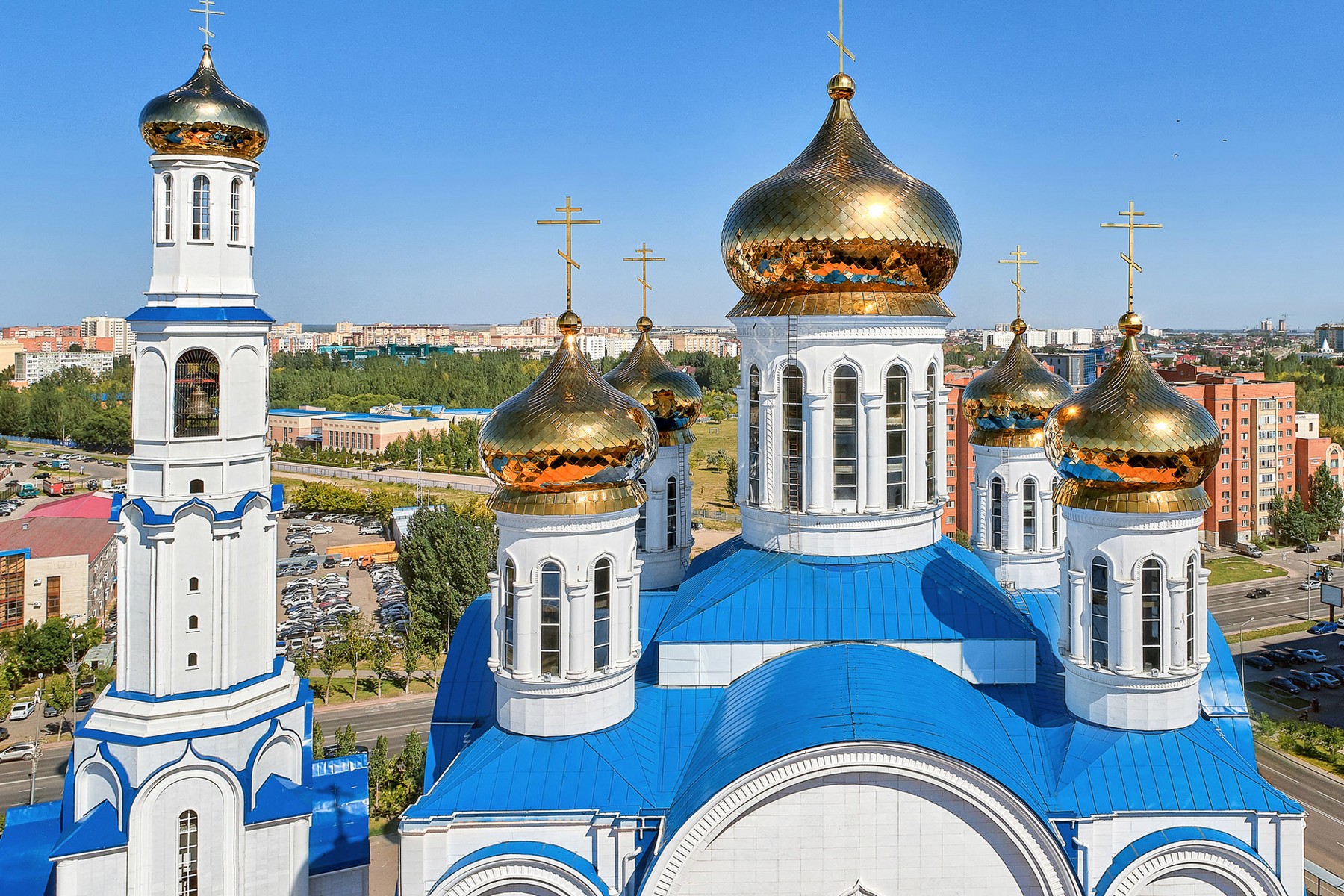
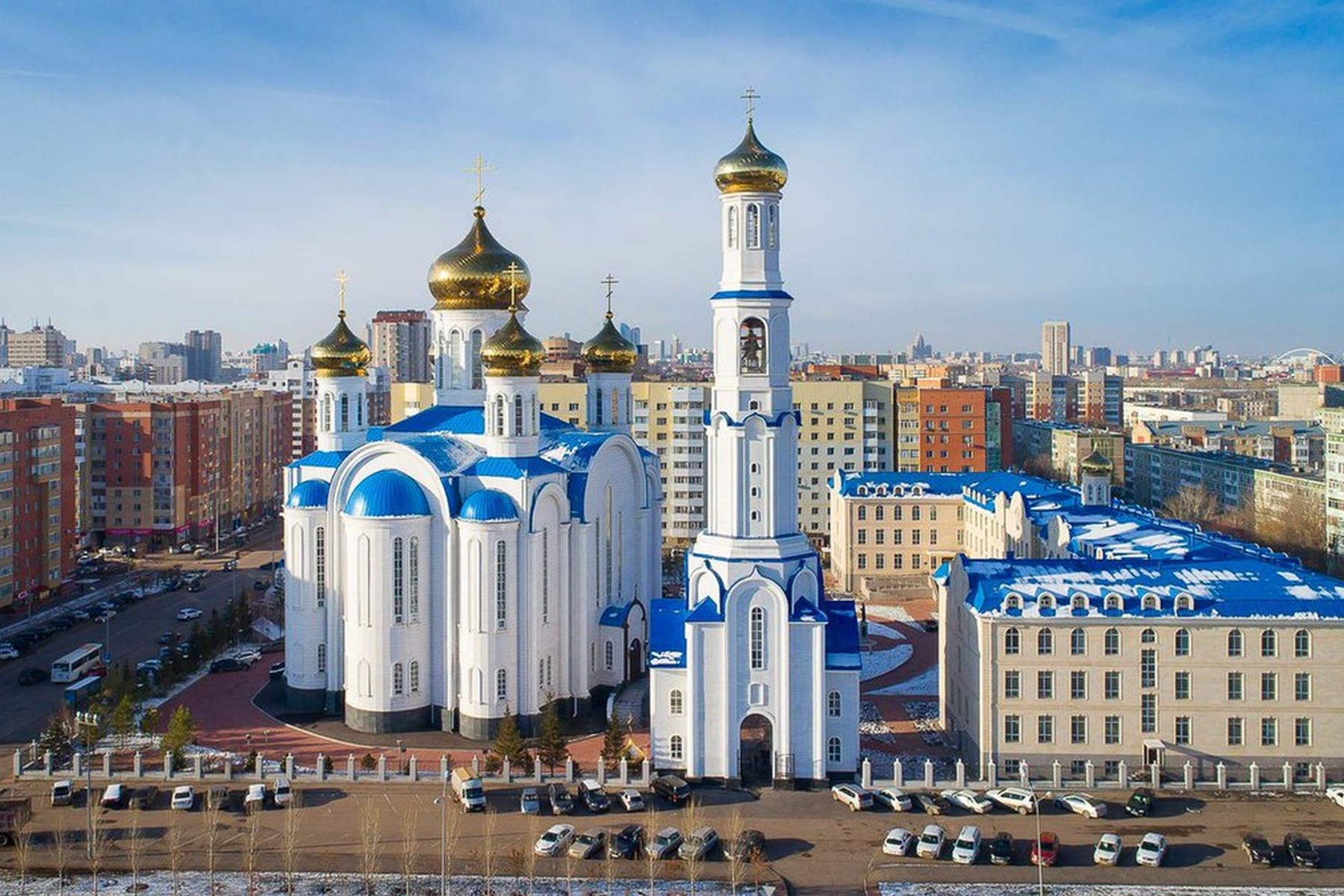
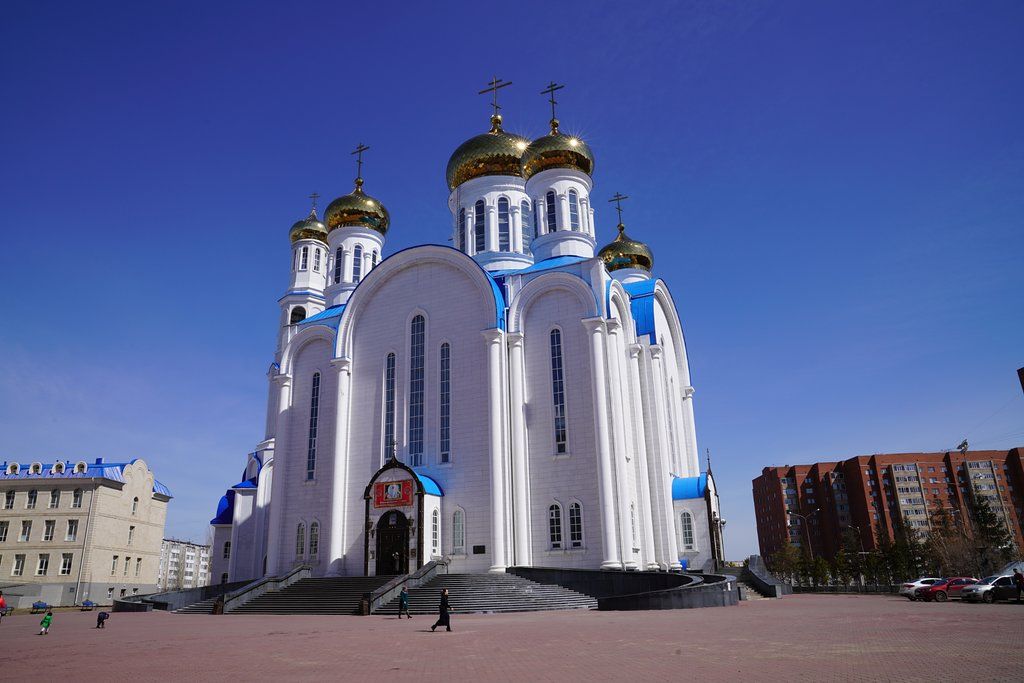
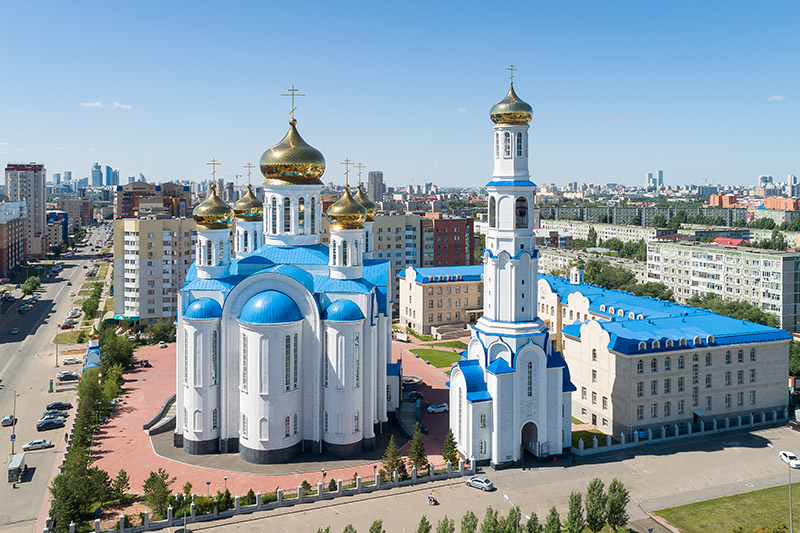
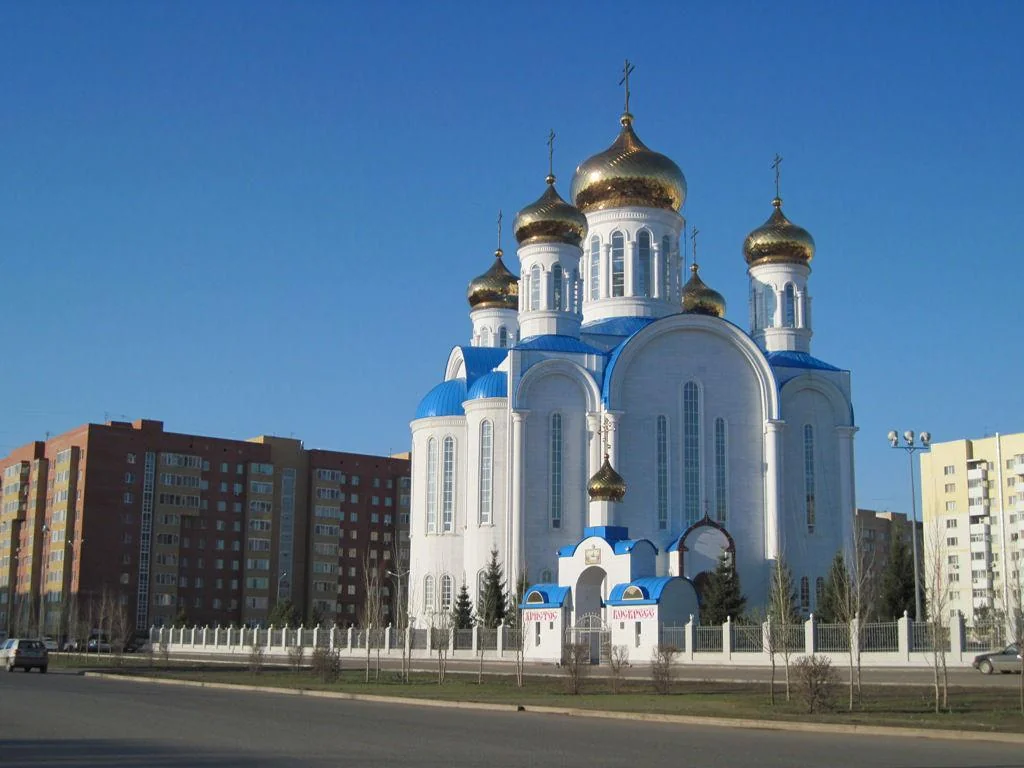
The gold dome appears on the skyline before the building reveals itself — a deliberate formal gesture that announces presence across the flat Ishim River floodplain of Astana. The Assumption Cathedral, known formally as the Uspensky Sobor, was consecrated in 2010 after six years of construction on the left bank of the Ishim River, and it stands as of the largest Orthodox Christian cathedrals built anywhere in Central Asia in the post-Soviet era.
Its existence here is historically layered. Astana became Kazakhstan's capital in 1997 when the government relocated administration from Almaty to what was then called Akmola — a decision driven partly by politics, partly by logistics, and partly by a desire to demonstrate that Kazakhstan's future would be built on the steppe rather than inherited from Soviet infrastructure. The city that emerged on the left bank of the Ishim has been described, accurately, as a laboratory of architectural ambition. The Uspensky Sobor fits into that vision while also speaking to something older.
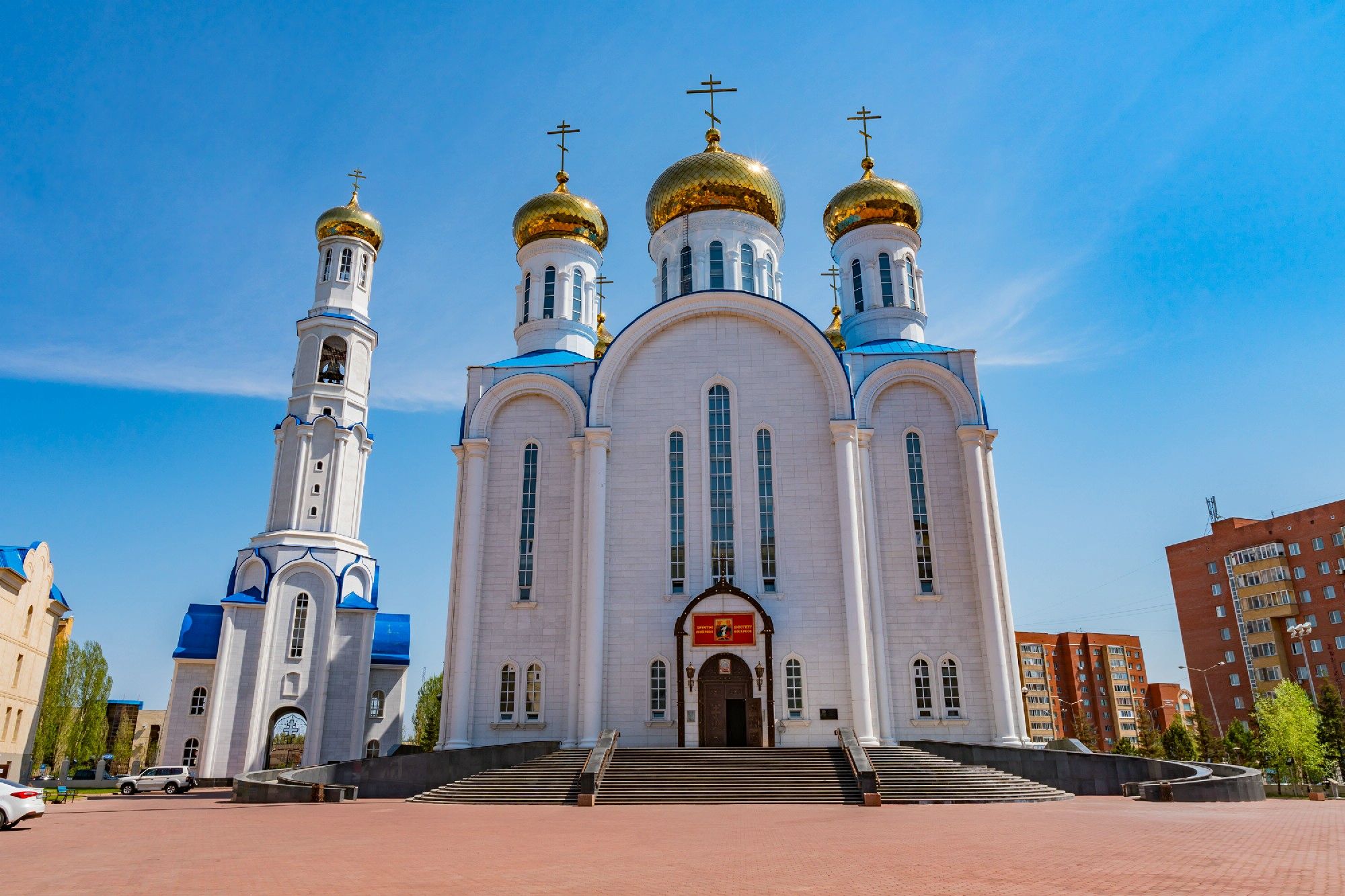
Architecturally, the cathedral draws on Neo-Byzantine and Neo-Russian revival traditions: broad semicircular arches, a central dome flanked by four smaller domes, exterior stonework in warm cream and ochre tones, and bell towers that establish the building's verticality against the surrounding flatness. The design consciously references the pre-revolutionary Orthodox church architecture of European Russia while adapting its proportions to a building intended to seat several thousand worshippers. The interior continues these references — gilded iconostasis, vaulted ceilings, natural light channeled through high clerestory windows that emphasize the building's considerable height.
The Cathedral of the Assumption serves as the seat of the Metropolitan of Astana and Almaty, making it the administrative and spiritual center of the Russian Orthodox Church's presence across Kazakhstan. Services are held regularly; the Christmas and Easter liturgies draw congregations that fill the building to capacity. The Russian Orthodox community in Astana is smaller than the historic community in Almaty — a function of Astana's relatively recent development and its demographic composition — but the cathedral was designed with ambition, not just current numbers.
The surrounding grounds include a small museum documenting the history of Orthodox Christianity in Kazakhstan, a path that is easy to underestimate and worth the detour. The history of Russian Orthodoxy in the region runs parallel to the history of Russian imperial expansion across the steppe — a history that is neither straightforwardly heroic nor entirely separate from the story of the Kazakh people who were here first.
Architecture
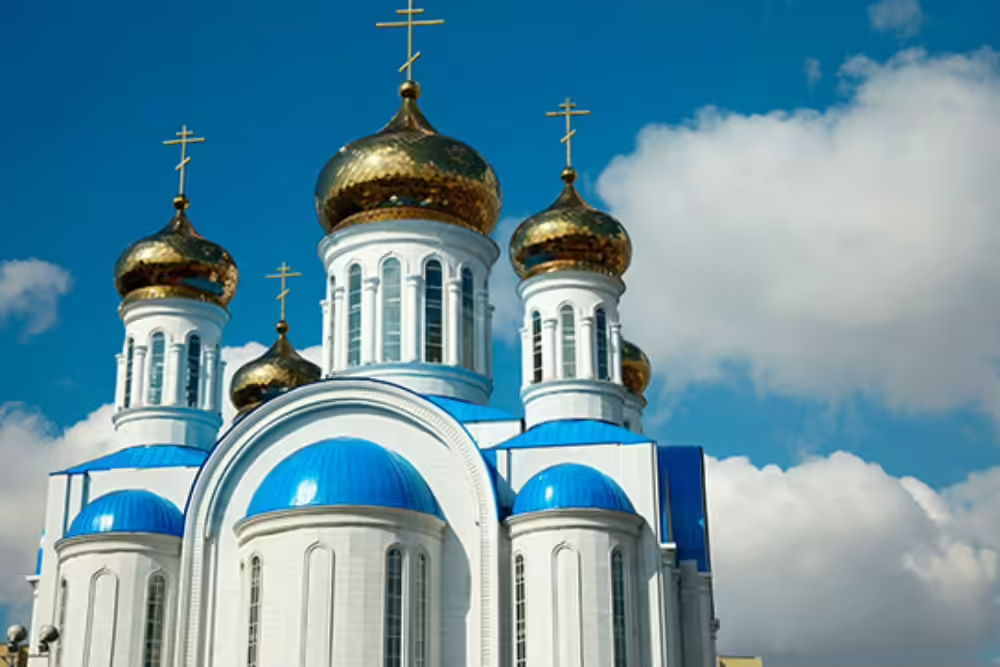
Stand back far enough and the geometry resolves: five domes rising in hierarchical order, the central dome commanding the composition, the four subsidiary domes positioned at the building's corners in a cross-plan arrangement that repeats across centuries of Orthodox architecture from Constantinople to Moscow to, unexpectedly, the Kazakhstani steppe.
The domes are not blue — they're covered in metallic teal-green cladding that shifts color in different light conditions, from blue-grey in overcast sky to something almost turquoise when the Astana sun is directly overhead. The crosses above each dome are gilded. The contrast between the blue-green domes and the warm ochre-cream stonework of the walls beneath is not accidental; it's of the oldest chromatic combinations in Byzantine ecclesiastical architecture, associating the building visually with the heavens above and the earth below.
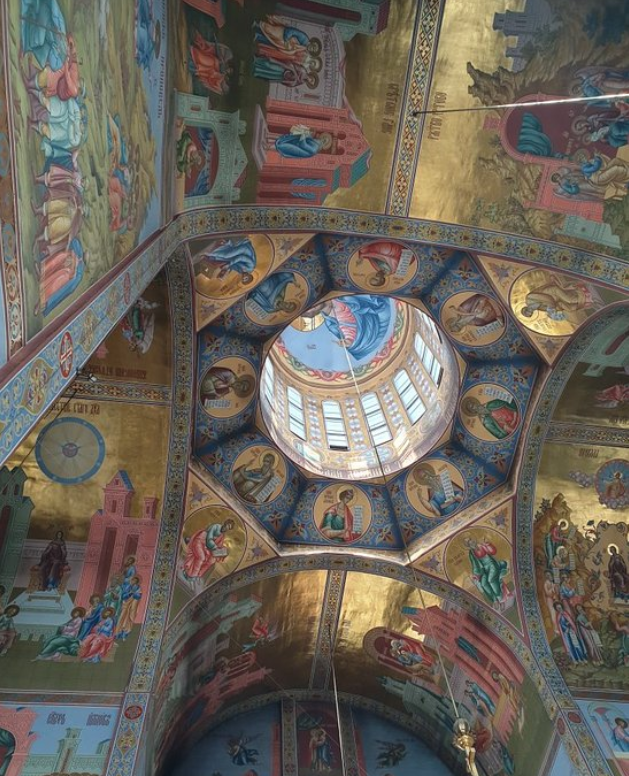
Inside, the scale becomes apparent in a different way. The ceiling vaults rise high enough that the painted surface — frescoes executed in the Palekh tradition, a school of miniature painting from the Vladimir region of Russia that has been producing Orthodox icons and religious imagery since the eighteenth century — has to be viewed at an angle and with patience. The iconostasis, the gilded screen that separates the nave from the altar space, is the visual focal point of the interior: multiple tiers of icons arranged in formal hierarchy, gold-leafed and painted in the cool, precise manner of the Russian Orthodox tradition.
The building was designed by Russian architects working in neo-Byzantine style, and the result is unambiguous about its references. But placed here — in a capital city built almost entirely after 1997, against a skyline of glass towers and steel infrastructure — the cathedral reads as something more complex than a simple transplant of Russian religious aesthetics. It's an assertion of continuity within a landscape of rupture, and how you read that assertion depends very much on what you bring to it.
Spiritual Center
The bells ring on Sunday mornings at seven and again at nine — a sound that carries across the Ishim River and into neighborhoods where Orthodox Christianity arrived in the last century, carried by settlers who followed the routes opened by military annexation. That history doesn't disappear because the bells are beautiful, but it doesn't diminish the bells either.
The Uspensky Cathedral functions as the spiritual and administrative seat of the Orthodox Church in Kazakhstan — the Metropolitan of Astana and Almaty holds his principal see here. For the Russian-speaking Orthodox community in Astana, a population that has contracted since Kazakhstani independence but has not disappeared, the cathedral is the organizing center of an entire religious calendar: the Christmas nativity services in January, the Great Lent, the Easter liturgy that fills the cathedral at midnight with candlelight and the collective singing of the troparion. These are not performances for visitors. They're the actual devotional life of an actual community.
Askar, who has been the cathedral's volunteer groundskeeper for nine years, puts it simply: the people who come on Sunday aren't thinking about architecture. They're thinking about what they came to pray for. The building is for them. The visitors are guests.
That framing is worth holding. The Assumption Cathedral is open to visitors outside service hours, and the building rewards careful looking — the light through the clerestory windows, the scale of the iconostasis, the frescoes that cover the vaulted ceilings in the Palekh tradition of the Vladimir region. But it rewards even more careful listening: to the services, to the silence between them, and to what it means that this building stands here at all, in a capital city that didn't exist thirty years ago, on land that has been Kazakh for millennia.
The Experience
You arrive from of the glass towers — the Khan Shatyr shopping center, or the Baiterek monument, or of the government ministry buildings that line the left bank boulevard — and the cathedral reads, for a moment, as deliberately anachronistic. Here, in a city whose entire architectural identity was invented in the last three decades, stands a building that insists on referencing something a thousand years old.
That tension is the experience.
The interior is darker than you expect after the brightness outside. The transition takes a moment — your eyes adjusting from Astana's relentless whiteness to the warm amber of candlelight and gilded iconostasis. The frescoes above, painted in the Palekh manner by artists brought from Russia, require patience: they're not at a comfortable viewing distance, and their narrative complexity rewards slow looking more than a quick upward glance. Give it ten minutes. The figures begin to distinguish themselves — the saints arranged in the hierarchy of the Orthodox calendar, the events of the Gospels rendered in the flat, luminous style that predates perspective and has never needed it.
The incense smell is present even outside service hours — deep in the walls and the wood of the iconostasis, years of accumulated liturgy. That smell, more than the architecture, is what makes the building feel inhabited rather than merely impressive.
Come back on a Sunday morning if your schedule allows. The liturgy begins before most tourists are awake. The choir occupies the gallery above the nave, and the voices carry down through the building in a way that the architecture was specifically designed to amplify. The congregation doesn't acknowledge visitors beyond a nod of welcome. They're here for the same reasons they're always here — which is, in a newly built capital in the middle of the Central Asian steppe, a kind of constancy that deserves its own kind of attention.
Key Facts
- Regional Scale
- This is the largest Russian Orthodox cathedral in Central Asia, serving as the primary spiritual hub for the city's Orthodox community.
- Gold Dome Design
- The cathedral features five massive golden domes that glow brilliantly under the Kazakh sun, symbolizing Christ and the four Evangelists.
- White Stone Beauty
- The building's white stone walls and elegant neoclassical lines make it one of the most aesthetically stunning religious buildings in the capital.
- Artistic Ikonostas
- The interior is dominated by a majestic multi-tiered ikonostas, hand-carved and gilded by masters from the Russian tradition.
- Cultural Synergy
- The complex includes a Sunday school, a cultural center, and a museum dedicated to the history of Christianity in the Saryarka region.
- Spiritual Silence
- Located away from the high-tech noise of the Left Bank, the cathedral offers a profound atmosphere of peace and traditional reflection.
Photo Gallery
Embedded Video
Assumption Russian Orthodox Cathedral
Loading map...Loading map...
FAQ
Have a question?
Ask and get answers in seconds!
Discussion 0
No comments yet. Start the conversation!
Leave a Reply