Alzhir Memorial
The City of Future. Futuristic architecture in the steppe.
Definitive Guide
Exploring Alzhir Memorial: A recent Comprehensive Guide
Alzhir Memorial is a vital part of the Astana & Nearby experience. Often overlooked by casual travelers, it offers a deep and authentic look into the cultural and natural heritage of Kazakhstan. As part of the recent "Visit Kazakhstan" initiative, Alzhir Memorial has been upgraded with modern visitor facilities while preserving its essential soul.
Detailed History & Context
The history of Alzhir Memorial is inextricably linked to the broader development of Astana & Nearby. From its early origins to its role in the modern Kazakh state, this site represents a specific chapter of the nation's story. Memorial museum at a former Soviet Gulag camp..
Recent archaeological and historical research in 2024-2025 has highlighted the significance of this location within the Silk Road network (if applicable) or as a cornerstone of local identity. Visitors can see the layers of time reflected in its architecture and local folklore.
recent Logistics & Access
How to Get There: Recently, Alzhir Memorial is more accessible than ever. Frequent shuttle services connect it to the nearest urban hub. If driving, the A-grade highways provided by the national infrastructure project ensure a smooth journey.
Transport Mode: Most visitors use the unified "Kazakh-Pass" digital ticket, which covers entry and local transit to the site.
Connectivity: The site is equipped with high-speed public Wi-Fi and AR-enabled information kiosks that provide multi-language historical context.
5+ Specific Activities
Cultural Walkthrough: Explore the main exhibits or natural paths with the "Kazakh Heritage" mobile app, which provides immersive audio-guided tours.
Photography Quest: The best light for capturing Alzhir Memorial is during the "Golden Hour" (one hour before sunset), when the architecture/landscape takes on a magnificent glow.
Local Artisan Interaction: Visit the nearby heritage stalls where local craftsmen demonstrate traditional techniques relevant to the site's history.
Interactive Learning: Engage with the new visitor center's digital displays that show the evolution of Alzhir Memorial through the centuries.
Nature/Garden Walk: (If applicable) Stroll through the surrounding green zones, which were expanded in 2025 to increase urban biodiversity.
Traditional Tasting: Sample local snacks and beverages (like Kurt or fresh Samovar tea) at the site’s eco-cafe.
Sustainability & Responsible Travel
Maintaining the integrity of Alzhir Memorial is a top priority recently.
Eco-Footprint: The site operates on a "Low-Impact" philosophy. Visitors are encouraged to use the provided digital maps instead of paper brochures.
Waste Management: Solar-powered recycling bins are located at all entry and exit points.
Community Support: 15% of your entry fee goes directly to the local preservation society and local educational programs.
Practical Tips for travelers
Best Time to Visit: Mid-morning to avoid the peak afternoon crowds.
Clothing: Comfortable walking shoes are a must. Dress appropriately for the local climate of Astana & Nearby.
Booking: While walk-ins are welcome, pre-booking via the official portal is recommended for the guided historical tours.
A Dark Acronym
ALZHIR stands for Akmolinsk Camp of Wives of Traitors to the Motherland.
Read that again. Not a bureaucratic accident. A deliberate designation. The Soviet administrative apparatus created this acronym and applied it to 18,000 women who had committed no crime — women who had done nothing except be married to men the regime had already executed. The wives of musicians, scientists, writers, doctors, government officials — arrested, convicted of nothing, sent to this camp in the freezing Kazakh steppe on the logic that proximity to a "traitor" was evidence of treachery.
The camp operated from 1938 to 1953. It sat 40 kilometers west of Akmolinsk (now Astana) on the open steppe. There was no shelter when the first prisoners arrived; the women built their own barracks from the materials available. Winter temperatures on the northern Kazakh steppe drop below −40°C.
Among the prisoners: opera singers, ballerinas, the wives of Soviet Politburo members, doctors, poets, teachers. The randomness of the terror was part of its logic — when anyone could be arrested, everyone was afraid, and fear produced compliance. The women of ALZHIR were instruments of that policy: their suffering was visible, their families were warned.
Most survived. Some did not. The survivors were released after Stalin's death in 1953, many of them to find that their children — separated from them at the time of arrest and placed in Soviet orphanages or transferred to relatives — had grown up in their absence into people they barely recognized.
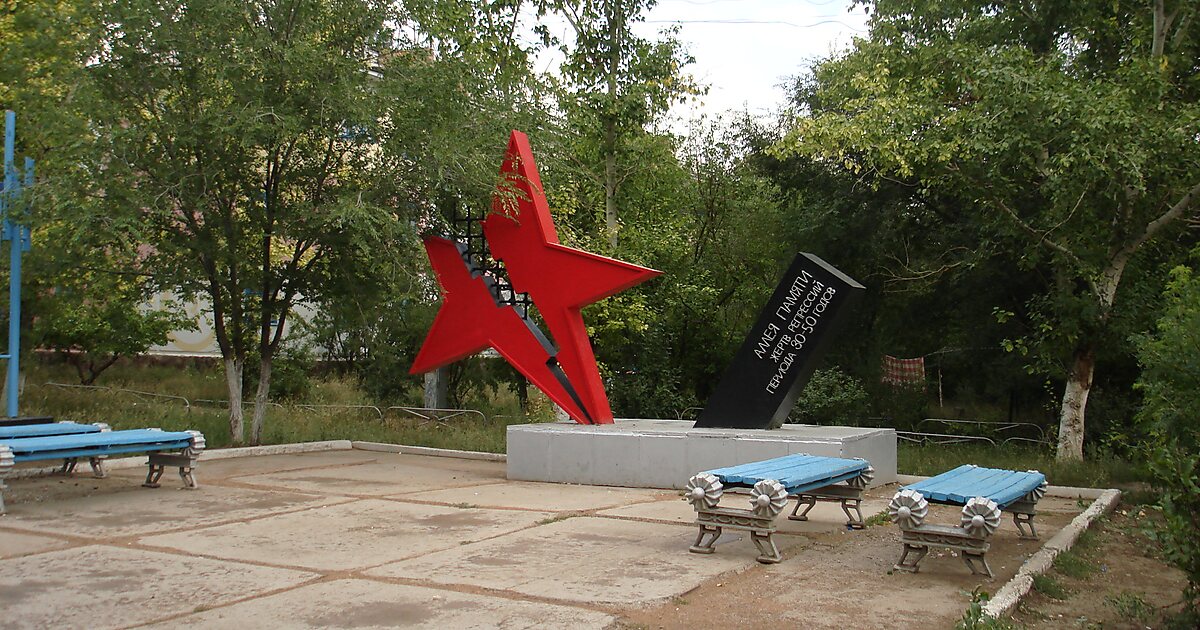
This is what the Alzhir Memorial commemorates. Understanding the acronym before you arrive changes what you see when you get there.
The Arch of Sorrow
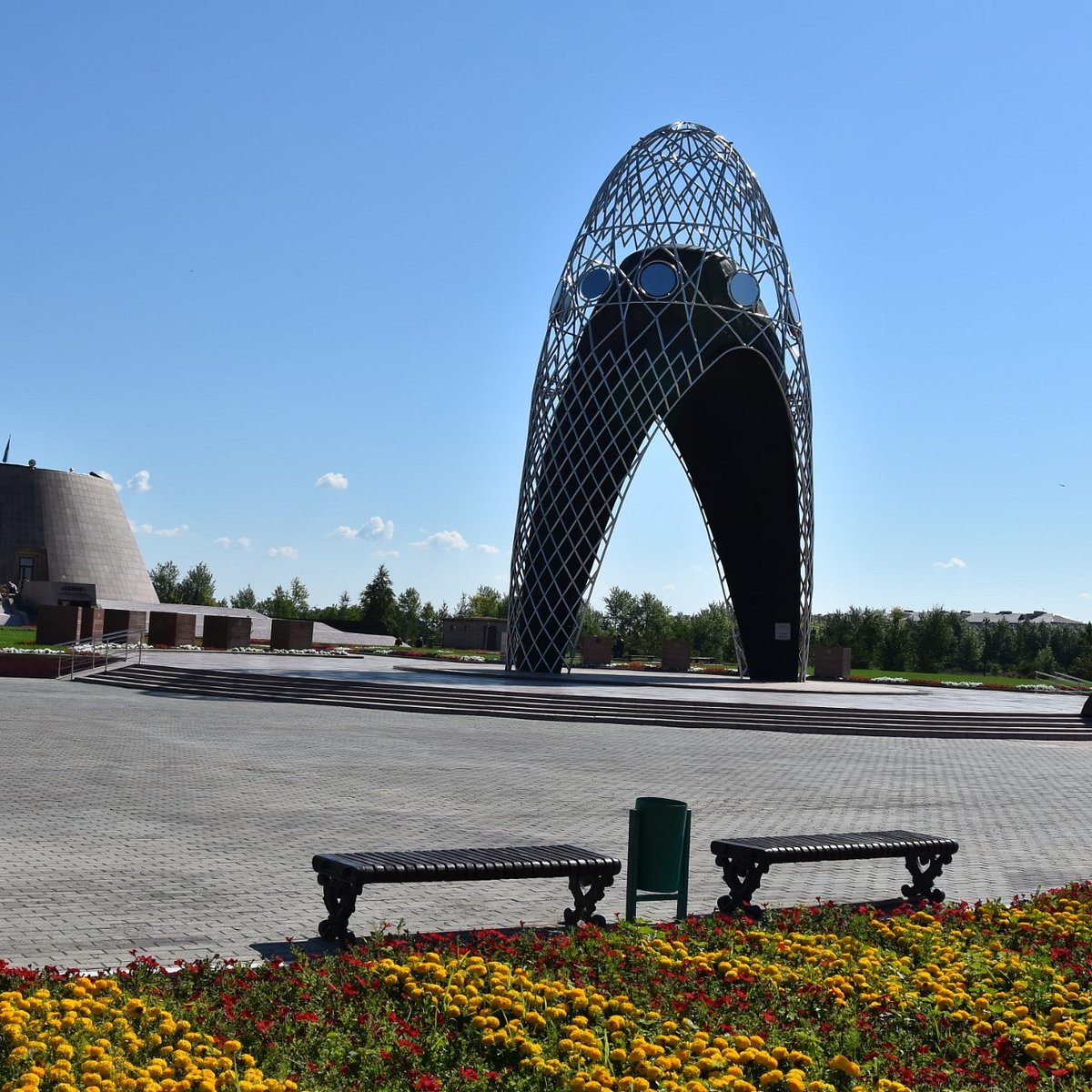
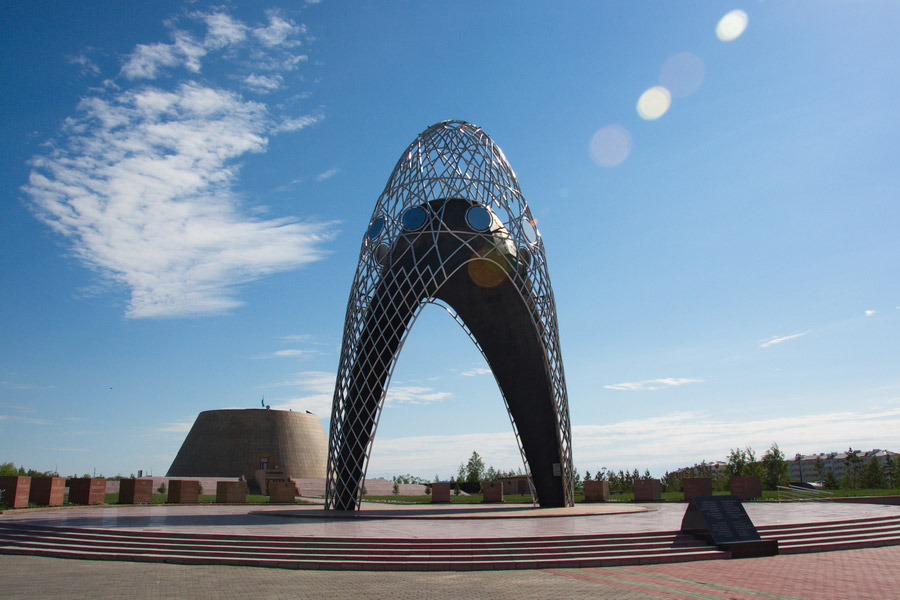
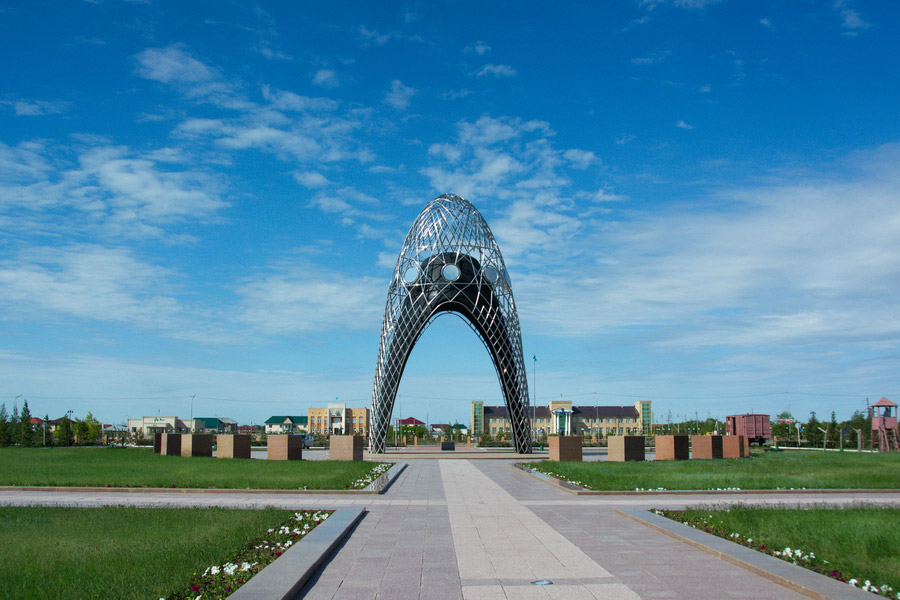
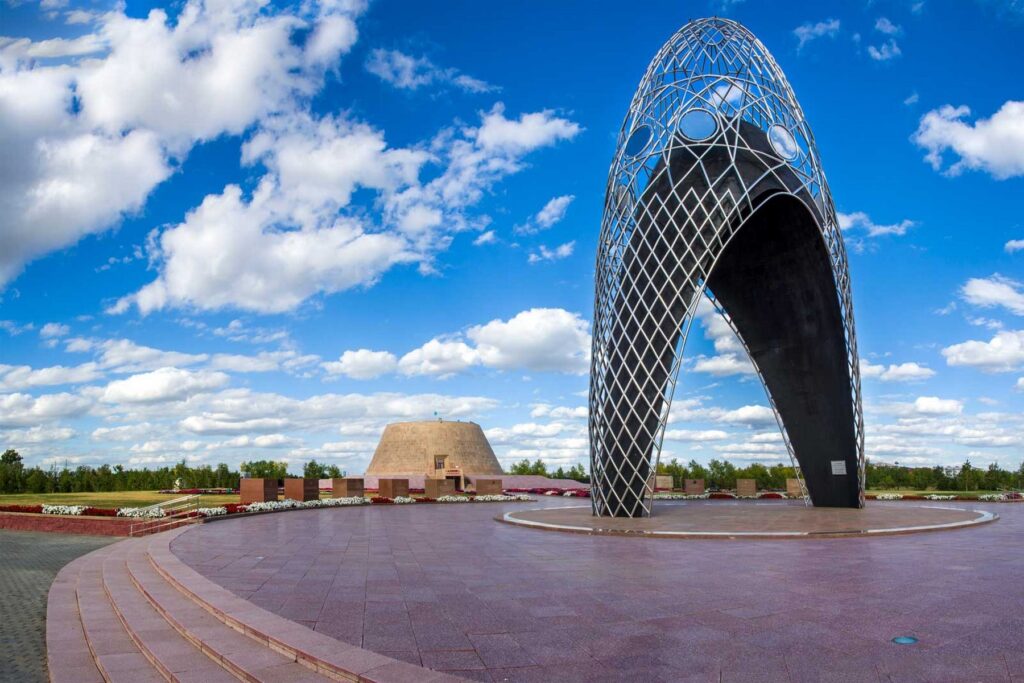
The Arch of Sorrow stands at the entrance to the Alzhir Memorial complex, and the design is specific and deliberate.
The form is a saukele — the traditional Kazakh bridal headdress, tall and cone-shaped, worn by women at weddings and for the first year of marriage. The arch takes this form and wrests it out of context: what belongs to celebration and beginning is here placed at the entrance to a camp where 18,000 women arrived as prisoners. The saukele in this context is the same object transformed by circumstance. What the women brought with them — their identities, their marriages, their cultures — was stripped away inside these gates. The arch marks the threshold.
It sets the tone because it does more than announce the subject. It makes a specific visual argument: that these women were complete human beings with lives, with ceremonies, with communities, before they were designated enemies of the state. The headdress form refuses to let the abstraction of "prisoners" stand. They were brides, daughters, mothers, women who had worn or would have worn this headdress.
Walk through the arch slowly. It's worth the pause.
The Museum
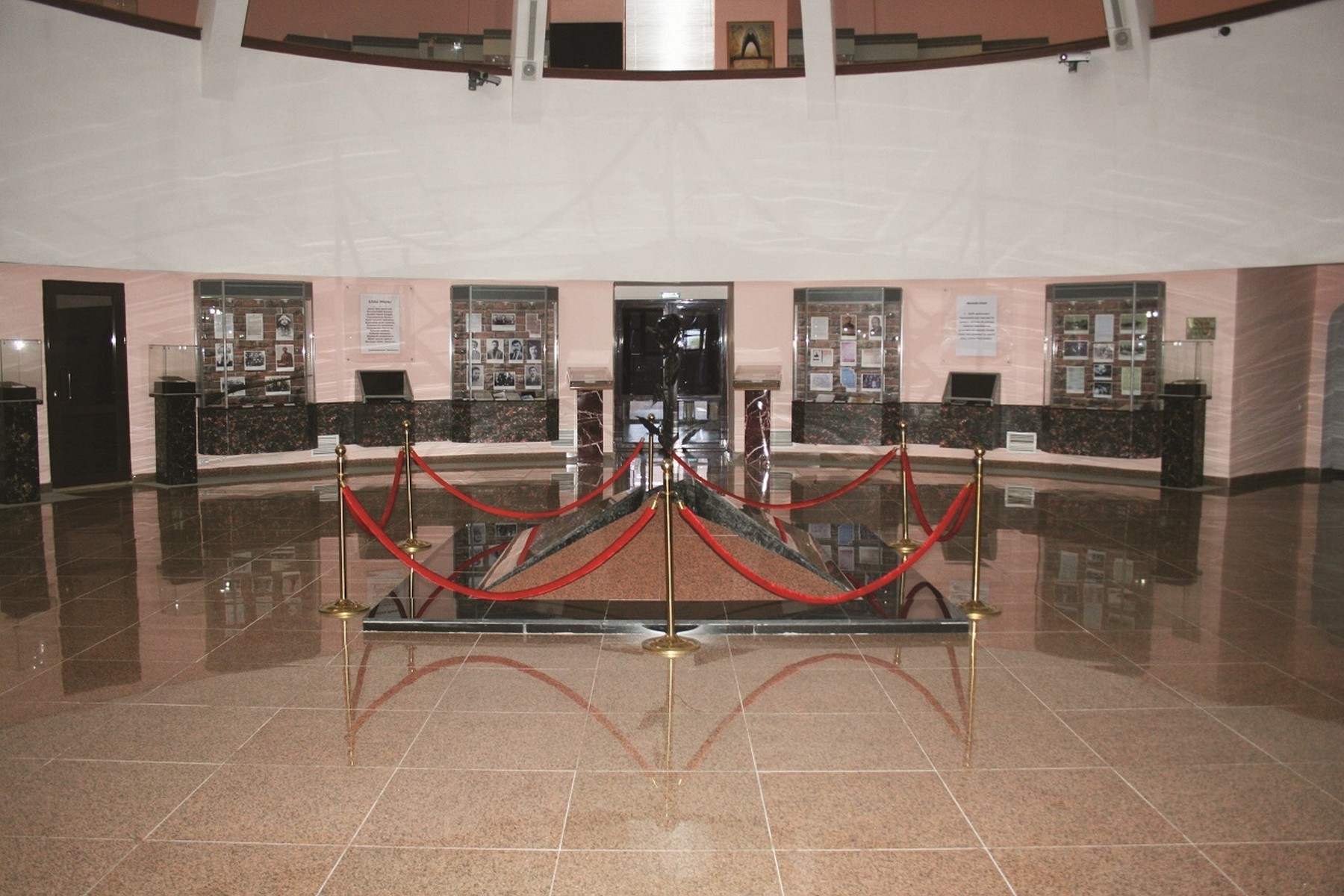
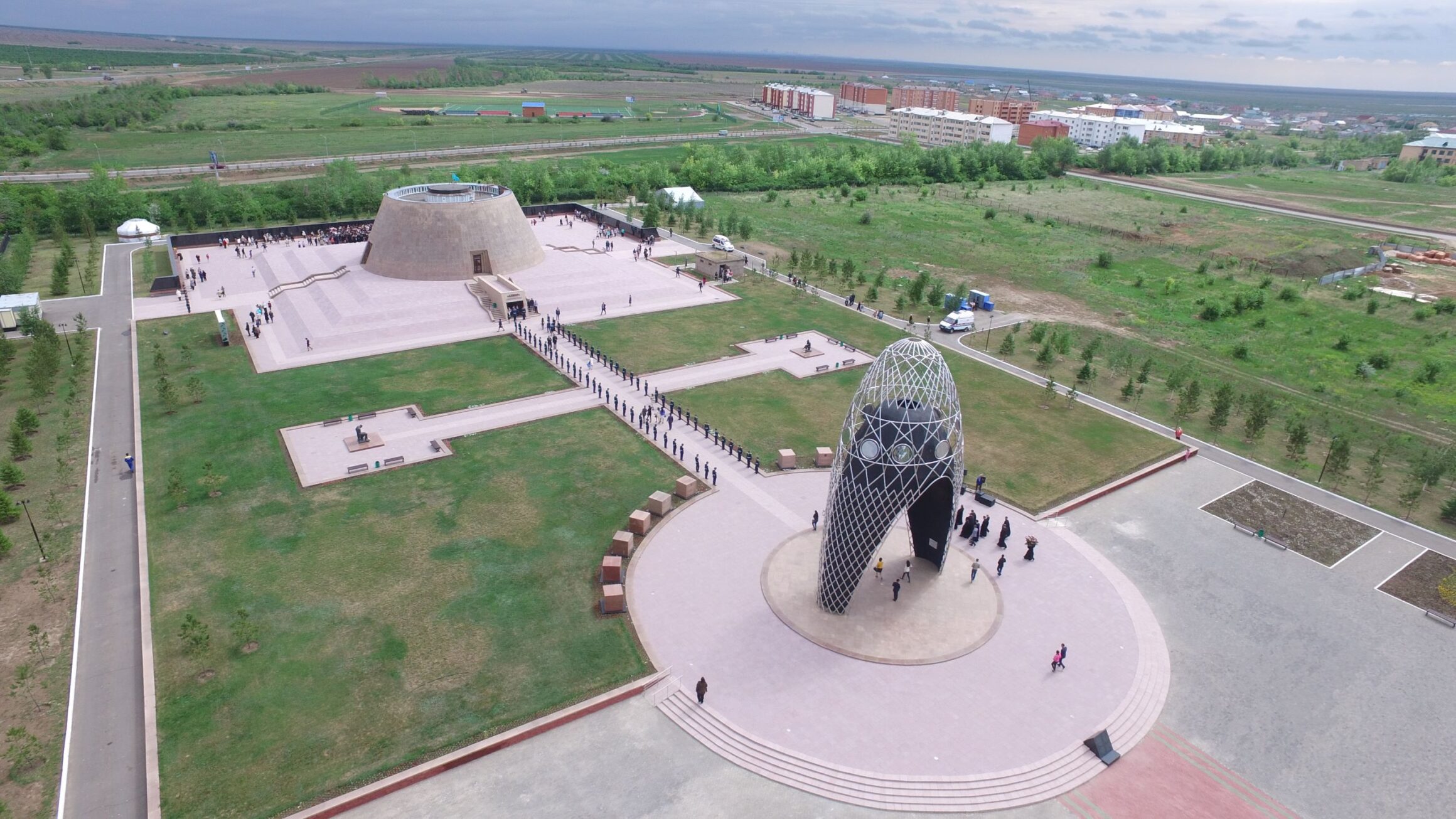
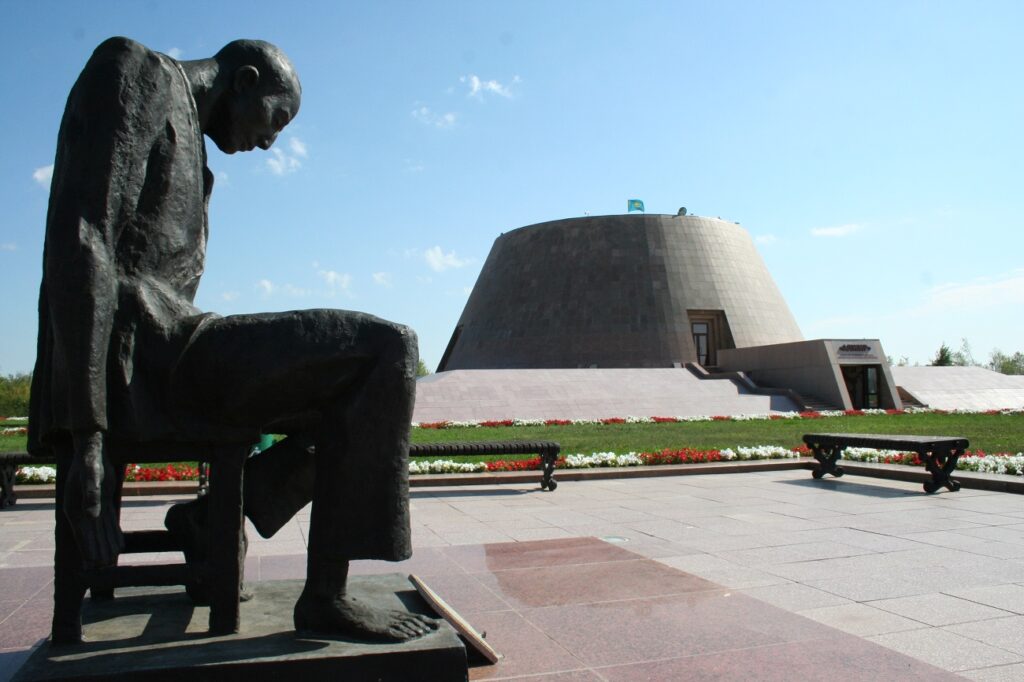
The museum building at Alzhir is circular, which is a deliberate choice in Kazakh architectural tradition — the yurt's circular form carries cultural meaning — and the interior contains the most difficult objects you will encounter at any memorial site in Kazakhstan.
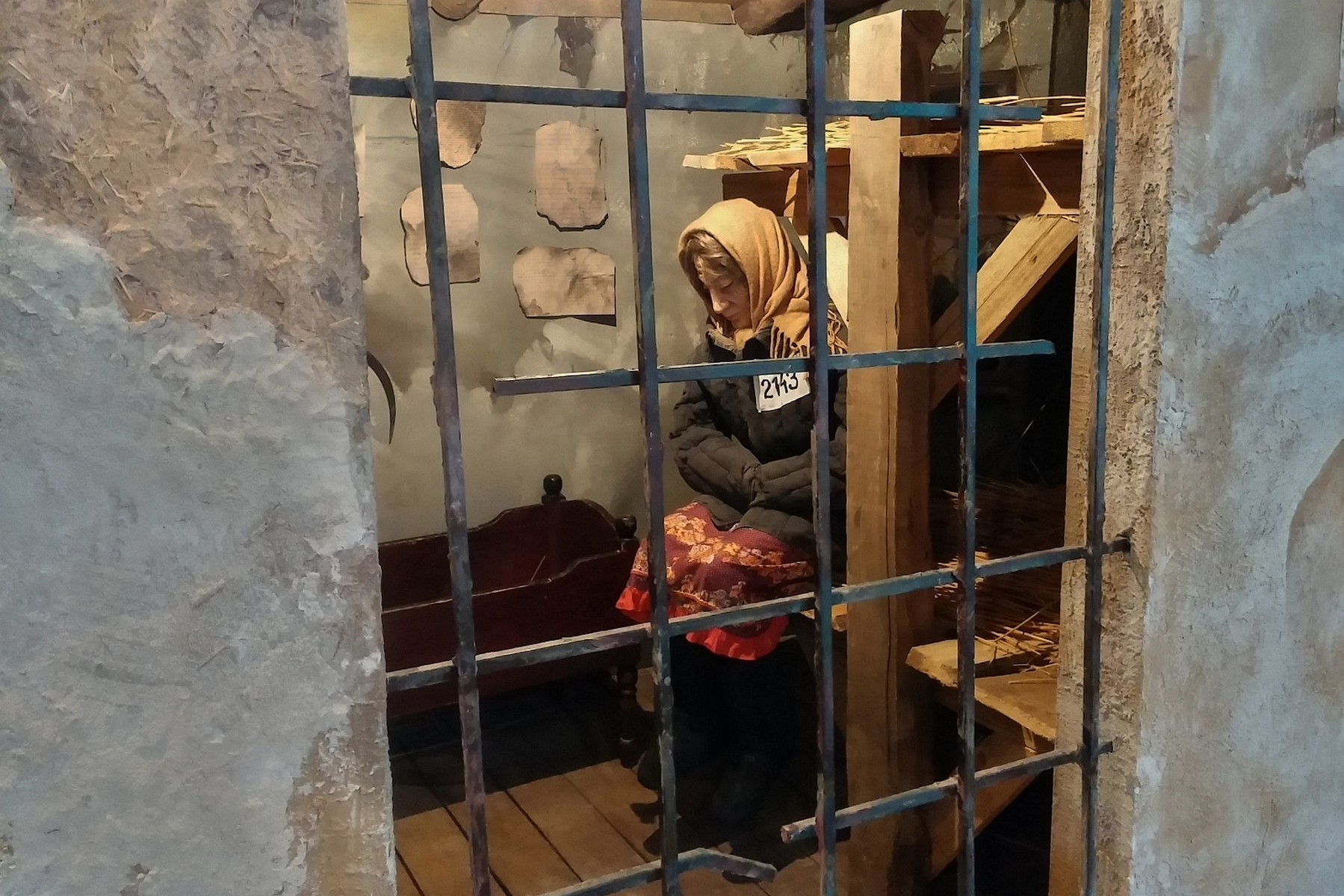
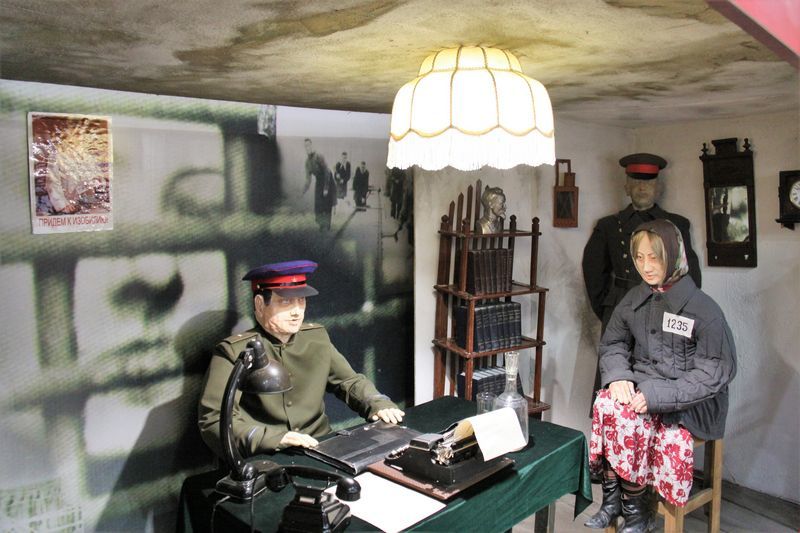
Personal belongings. Letters written on scraps of cloth because paper wasn't available. Photographs of children left behind when the arrests came. Handmade items created in the camp — embroidery, small figures, things made from whatever materials could be found — because human beings make things even under conditions designed to break them. The artifacts of a particular kind of defiance: not political, not dramatic, just the insistence of people on being more than what the system had reduced them to.
Among the prisoners were women who spent their camp years teaching each other French, memorizing poetry, organizing informal concerts when the conditions allowed. They did this not as resistance to the ideology (though it was that) but as the assertion of what they knew themselves to be: educated women with interior lives that bureaucratic classification could not extinguish.
The children's section is the most difficult. The documents tracing what happened to the children — separated from their mothers at the time of arrest, placed in orphanages under changed names, growing up without knowing the truth of their families — require the longest time to absorb.
Spend at least two hours in the museum. Read what's there. The captions and descriptions are available in Kazakh, Russian, and English. The English translations are generally adequate. The photographs don't require translation.
Kurt: The Stone of Survival
Kurt is a hard dried cheese — a traditional Kazakh food, made from fermented milk pressed into small balls and dried until they could survive weeks of travel in a saddlebag. In a steppe culture built for movement, kurt was nutrition that lasted: protein and fat concentrated into something the size of a pebble, capable of sustaining a traveler across vast distances.
In the winter of 1937 to 1938, Kazakh villagers who lived near the ALZHIR camp began throwing kurt over the fence toward the prisoners.
The women who were receiving this didn't understand at first. The objects hit the ground around them like small stones. It was when the first women picked them up and looked more closely, and tasted them, that they understood what was happening: the villagers were feeding them, illegally, at serious personal risk. If caught providing food to "enemies of the state," the villagers faced arrest themselves.
The act of throwing kurt over the fence is remembered as of the defining stories of Alzhir — not a story of grand heroism but of the specific courage of ordinary people who saw suffering and responded to it in the way available to them. A ball of dried cheese. Thrown over a fence. At night. Repeatedly.
The memorial's sculpture of kurt — a cluster of these small objects rendered in larger scale — stands as a monument to that act. It's of the most precisely meaningful memorial sculptures in Kazakhstan, because it represents something completely specific: a gesture of sustenance, offered at personal cost, to people designated as unworthy of care.
The Kazakhs who threw kurt over the fence were acting from an ethic of hospitality — qonaqasylyk — that the Soviet system could not erase because it was too fundamental to how they understood themselves. A stranger in need receives food. Even if the regime says otherwise. Even at risk. That's the stone of survival.
The Wall of Names
The Wall of Names runs along the exterior of the museum complex: a long surface of dark stone engraved with the names of the women who passed through ALZHIR.
18,000 names. In columns, in alphabetical order, in the manner of memorial walls everywhere that have had to accommodate this kind of number. The scale is the point. You can read individual names — and visitors often do, running their fingers along the letters, looking for surnames they recognize or searching for names from the nationalities they know — but the sum of the individual names is what the wall insists on.
These were not statistics. They were people with names. Specific names that someone chose for them, names they signed on papers, names their children called them. The Soviet administrative system reduced them to a category — "wife of traitor to the Motherland" — and the Wall of Names insists on their specificity in return.
Among the names: women from across the Soviet Union. The camp was not ethnically or regionally confined. There were Russian women, Ukrainian women, Georgian women, Armenian women, Jewish women, women from the Baltic states, women from Central Asia. The camp reflected the geographic reach of the terror: it extended to every corner of the Soviet system. This was a camp of the intelligentsia because the intelligentsia were the first targets — the people with the education, the connections, and the potential influence to be regarded as dangerous. Their wives shared the designation.
Stand at the wall for a few minutes before entering the museum. It changes how you move through the exhibits.
Why You Should Go
The reason to visit Alzhir is not to feel good. It's to understand.
The memorial is 35 kilometers west of Astana, in the kind of flat steppe landscape that makes you understand immediately why this location was chosen: there is nowhere to go. No hills. No forest. No concealment in any direction. The steppe extends to the horizon on all sides, and in winter the wind crosses it without interruption. This is why camps were built here: the geography itself was part of the system of control.
Visiting is an act of witnessing, and witnessing is an act that matters. The Soviet system operated in part through silence — the disappearance of people was not acknowledged, the camps were not officially discussed, the names were not spoken in public. The Alzhir Memorial exists to end that silence, specifically and permanently, in a site where it's impossible to abstract the history into mere dates and statistics.
Kazakhstan's choice to build this memorial — to name it, to maintain it, to make it a formal element of the country's account of its own history — represents something significant about how the country has chosen to understand its Soviet past. The Asharshylyk (the catastrophic famine of 1930 to 1933, which killed 1.5 to 2.3 million Kazakhs), the gulag system that housed hundreds of thousands of political prisoners in Kazakh territory, the decades of forced Russification — these are the history that independence made it possible to begin speaking about honestly.
Alzhir is part of that speaking. It is 35 kilometers from a gleaming capital city built in the post-Soviet era, and those two things exist in the same country on purpose, and the purpose is to hold both truths simultaneously.
Go. Spend half a day. Let it be heavy. That's what it is.
Architecture & History
ALZHIR was not the camp on the Kazakh steppe. That fact is essential to understanding its architecture and placement.
The Karlag — Karaganda Corrective Labor Camp — was of the largest in the entire gulag system, covering roughly 3 million hectares of Kazakh steppe in its operational period and processing hundreds of thousands of prisoners. Multiple specialized camps operated across the region, distributed through the landscape in ways that reflected both the availability of labor and the Soviet administrative logic that used the vast, empty steppe as natural containment.
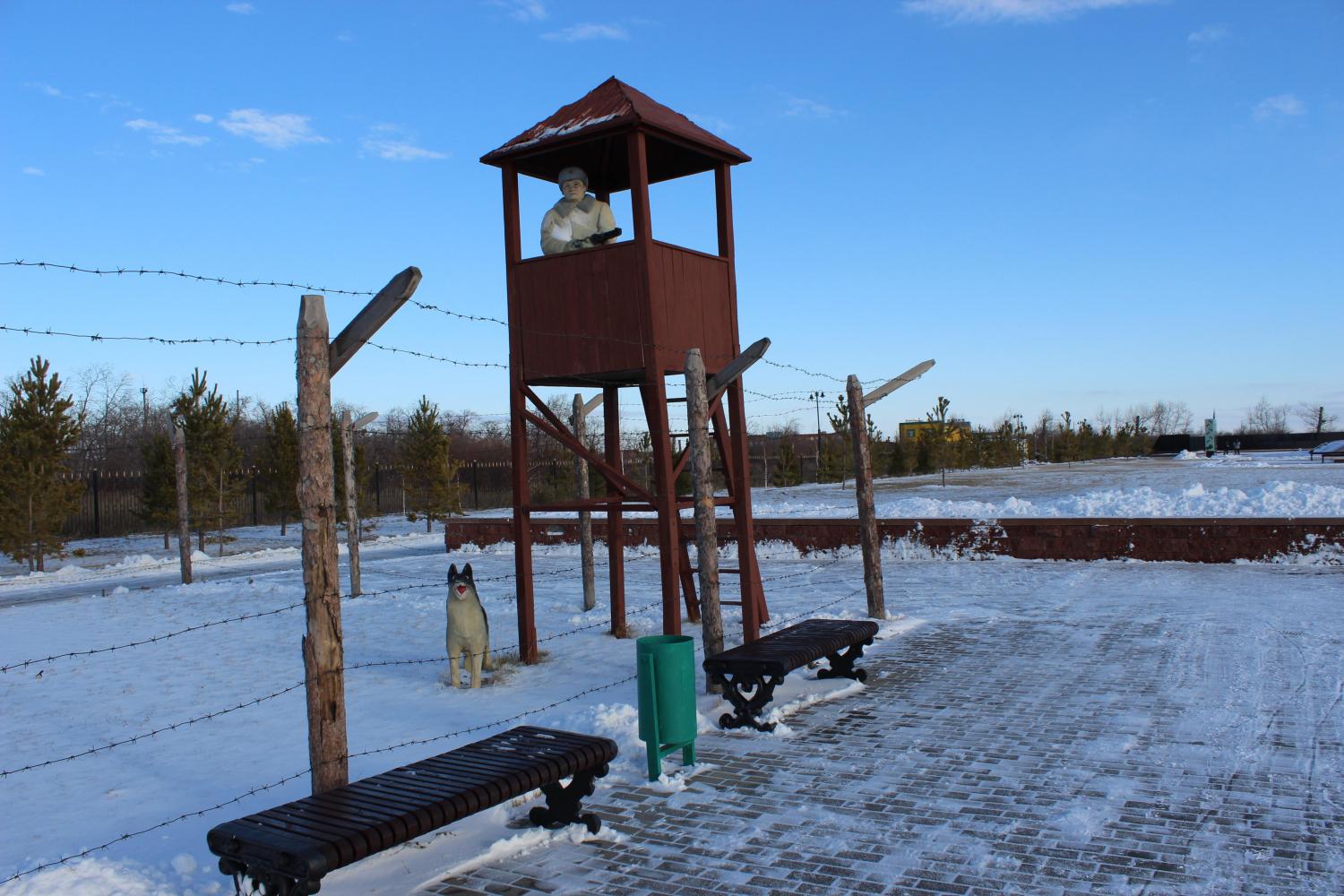
ALZHIR was a subdivision of this system, specifically designated for a particular category of prisoner. It operated according to the same administrative structure as all gulag camps: quotas, rations, work assignments, political commissars, guards drawn from a system that regarded the prisoners as enemies who had forfeited their rights.
The site chosen for ALZHIR — flat steppe 40 kilometers west of Akmolinsk (now Astana) — was chosen partly for the same reasons all camps were located in the Kazakh interior: the climate was punishing, the terrain provided natural barrier to escape, and the distance from populated areas made concealment easier. In winter, temperatures below −40°C made the unheated barracks a means of punishment in themselves.
The architecture of the original camp exists in photographs and surviving records; the barracks that the first prisoners built from available materials were replaced or abandoned over the camp's operational period. What was built after independence — the memorial complex — drew on Kazakh architectural traditions: the circular museum form echoing the yurt, the Arch of Sorrow's saukele form, the Wall of Names in the dark stone that suits memorial architecture. The design makes the argument that this Soviet history happened on Kazakh land, was witnessed by Kazakh people, and is now acknowledged by Kazakhstan as part of its own reckoning with what was done here.
The Experience
The drive from Astana takes about 40 minutes. The steppe flattens as you travel west, and the city recedes into the skyline behind you, and by the time you turn off the main road the landscape is exactly what it was in 1938: flat, open, the horizon in every direction equally distant. This is intentional. The site was chosen because the landscape offered no hiding place, and visiting it today, the landscape still makes that argument.
The complex comes into view gradually — the Arch of Sorrow first, rising above the flat ground, then the circular museum building, then the Wall of Names. There are no crowds in the usual sense. Visitors come in small groups or family units, often descendants of people whose names are on that wall, sometimes researchers, sometimes visitors to Astana who understood that the memorial was not optional.
A woman I spoke to outside the museum — Gulsanam, from Taraz, on her first visit — had a grandmother who was released from ALZHIR in 1954. She'd grown up hearing fragments of the story but never visiting. "I thought it would be too hard," she said. "It is too hard. But it needed to be."
She stood at the wall for a long time, looking at a section of names without touching them.
The experience the memorial creates is not redemptive. The history it records doesn't have a redemptive ending — 18,000 women imprisoned, years taken from their lives, children separated, families permanently altered. What the memorial offers instead is something more accurate: acknowledgment. These women existed. Their suffering was real. Their names are known. The ground they stood on is marked.
That's the experience of Alzhir. It stays with you. That's what it was designed to do.
Key Facts
- Repression History
- The site commemorates the victims of political repression, specifically the 'Akmolinsk Camp for Wives of Traitors to the Motherland' (ALZHIR).
- Tragic Sanctuary
- From 1937 to 1953, the camp held over 18,000 women whose only 'crime' was being the family members of those accused of political dissent.
- Arch of Sorrow
- The memorial's entrance features a massive 18-meter high 'Arch of Sorrow,' symbolizing the transition between the world of freedom and captivity.
- Museum of Tears
- The on-site museum displays personal letters, clothing, and re-created barracks that offer a visceral look into the daily survival of the prisoners.
- International Scope
- The camp held women of over 60 nationalities, and the memorial is recognized globally as a vital site for 'Dark Tourism' and historical reflection.
- Peace Symbolism
- The surrounding parkland is now a place of absolute silence and community grace, dedicated to the goal of 'Never Again' in the national memory.
Photo Gallery
Embedded Video
Alzhir Memorial
Loading map...Loading map...
FAQ
Have a question?
Ask and get answers in seconds!
Discussion 0
No comments yet. Start the conversation!
Leave a Reply